


Midnight Signals Case Files
Companion to Episode: Dyatlov Pass
Boris Slobtsov found a torch on the abandoned tent. It was a Chinese pocket torch, lying on snow that had settled over the canvas, and it was switched off. When he tried it, the light came on.
He had reached the campsite on 26 February 1959, as part of the search for Igor Dyatlov’s missing ski party. The entrance was still visible, but much of the tent lay under snow. Slobtsov and his companions began clearing it, looking for the people who ought to have been there. Instead they found the things those people had brought into the mountains: boots, food, blankets, clothing. There was money among the belongings. The group had left without taking the equipment they needed to survive outside.
The first bodies were found downhill. Yuri Doroshenko and Yuri Krivonischenko lay near the remains of a fire beneath a cedar. Igor Dyatlov, Zinaida Kolmogorova and Rustem Slobodin were discovered on the slope between the tree and the tent. The other four remained missing into May. When they were finally recovered from a snowy ravine, the investigation acquired some of its most disturbing details: severe fractures, missing soft tissue and clothing that would be sent for radiation testing.
It is usually at this point that the theories begin. A falling slab of snow, a weapons test, something seen over the ridge, something moving among the trees. The episode follows those possibilities through the evidence that has kept the case alive. Beside them sits a more intimate collection of material: a diary passed between friends, a young woman’s account of a visit to the cinema, a hunter’s statement to the prosecutor, the list of food stored for a return journey that never happened.
Those papers bring the hikers closer. They also leave awkward questions in place. The party could still make a fire after leaving the tent. Someone cut branches and arranged a shelter. Clothing passed from one person to another. Whatever happened on the slope, there was a period afterwards in which people were trying to keep themselves, and perhaps one another, alive.
The paid companion includes a closer reading of the diaries and investigation papers, three archival document facsimiles, a chronology, an annotated reading and viewing guide, and an illustrated case file to keep.
Before the ridge
Lyudmila Dubinina had enjoyed the film. At Vizhay, on the way north, several members of the party went to see Symphonie in Gold. In her diary, she remembered the songs and the pleasure of watching it with her friends. Igor was in a lively mood afterwards. There had been time on the journey for arguments about love, for sewing overshoes and copying songs, and for getting to know people better.
At the workers’ settlement known as the 41st Quarter, Dubinina watched the men they met and formed her own opinions about them. She liked talking with the older engineers. In other entries she could be impatient with her companions, pleased by an evening’s conversation, or absorbed in the arrangements for a meal. There was damp firewood to contend with and equipment to finish preparing before they could get on the trail.
Zinaida Kolmogorova’s diary gives another view of the company. In Serov, the hikers spent time at a school, showing the children their equipment and talking about their journeys. Semyon Zolotaryov, the older instructor who had recently joined the party, took part. By the time the travellers left, some of the children were reluctant to let Zina go. She recorded their goodbyes among the ordinary arrangements for the next train.
Later she wrote about borrowing Yuri Yudin’s mittens, which she was reluctant to give back. Yudin was still travelling with them then, carrying his share of the load and expecting to make the journey into the mountains. When he became unwell, the group redistributed what he was carrying.
They were not all students. Several had already moved into working life, while Zolotaryov was a hiking instructor. The expedition grew out of the sporting world around the Ural Polytechnic Institute in Sverdlovsk, now Yekaterinburg. Yudin’s testimony describes a planned route, assigned responsibilities, money collected for provisions and equipment supplied partly through the institute. This was a demanding winter journey undertaken by people with previous experience, rather than a spontaneous outing into unfamiliar snow.
The membership had changed during the preparations. Yudin told investigators that two prospective participants withdrew, and that Zolotaryov joined shortly before departure. Yudin did not know him beforehand. Asked about his conduct during the journey, however, he described him as disciplined and gave no complaint against him. The late arrival would become a source of suspicion in later discussions of the case. The surviving companion’s account is less dramatic.
By 28 January, Yudin’s leg was hurting badly enough for him to turn back. The remaining nine continued from the abandoned settlement of Second Northern. His departure divided the party’s papers as well as its journey: he could tell investigators what the group had planned and how it had travelled so far, but he could not tell them what happened at the final camp.
Music continued after he left. The shared diary describes Zina trying the mandolin with Rustem Slobodin’s help. Inside the tent, the suspended stove could make the space beside it uncomfortably hot. There were arguments about sleeping positions and jokes about improving the heating. Farther on, the diary became increasingly concerned with deep snow and the difficulty of breaking a trail.
On 31 January the group tried higher ground, met fierce wind and descended into the Auspiya valley to camp. Igor’s final entry describes the effort of making that camp and the relief of a warm dinner inside the tent. The next day they would leave supplies below and climb again.
The people whose trail they followed
The Mansi appear in the expedition’s own writing before they appear in the investigation. The hikers followed a hunter’s trail and noticed signs on trees. Their progress depended in part on routes made by people who knew the country through hunting and reindeer travel. The diary’s interest in those signs is curious and practical.
In the story as it spread, the relationship became more threatening. Kholat Syakhl, commonly rendered as Dead Mountain, offered an ominous name. Accounts of sacred ground and offended spirits supplied a possible reason for the party to have been unwelcome. The episode explores that older landscape of belief. The investigation, though, also preserves the words of a particular Mansi man who was asked about an attack.
Grigoriy Kurikov was fifty-seven, a hunter and a deputy of the Ivdel City Council. Questioned on 23 March, he said he understood Russian but signed in Mansi. He did not believe Mansi people had attacked the hikers. In the hunting country, he explained, news of strangers or violence would travel. He had heard nothing that supported such a story.
Kurikov also addressed the sacred mountain mentioned in the questioning. It was not guarded, he said, and Russians were allowed to visit. He denied having told the police that a group of people lived near the sacred place and feared the Mansi.
Kurikov ended by saying he could not understand how the deaths had happened. The prosecutor recorded the statement, which was read back to him before he signed it.
The canvas, weeks later
Slobtsov’s account of the tent was written in April. By then the campsite had been searched, the tent dismantled and the contents handled. He was remembering what he had done there in February.
He also recalled a gap between the tent and the first visible footprints. The tracks began some fifteen to twenty metres away. In places the compressed snow stood above the surrounding surface after looser snow had blown away. He could not give a precise count of the people who had made them. The familiar picture of nine clear sets of prints beginning at the canvas is tidier than this witness’s description.
The cuts were examined separately. In April, the worn cotton tent was pitched again with Yudin’s assistance so that the damage could be studied in its proper position. The examiner, Churkina, distinguished three cuts from the other tears. Their edges and the small marks beside them indicated that a blade had been applied from inside. The report was completed on 16 April.
That finding is one of the firmest and strangest parts of the case. It still does not identify the person holding the blade, the reason for using it or the order in which the party left. Nor does it turn every hole visible in a photograph of the damaged tent into an escape cut. The examination concerned particular marks in canvas that had already undergone a winter on the mountain and removal by the search party.
There was no shortage of equipment inside. The episode describes the warmth and shelter the hikers had abandoned. The records make one small correction worth carrying into the companion: the bedding included blankets. Descriptions of nine people climbing out of individual sleeping bags impose a different arrangement on that cramped interior.
The tent, the tracks and the bodies were found on different days. Searchers worked through the area, moving equipment and recovering their friends. By the time the canvas reached the examiner, four members of the party were still missing.
Work in the forest
The cedar and the ravine are close enough to be joined in a short retelling, but they held different traces of the party. Beneath the cedar were the remains of a small fire and the bodies of Doroshenko and Krivonischenko. Broken branches above them suggested activity in the tree. Between the forest and the tent lay Dyatlov, Kolmogorova and Slobodin. Searchers interpreted their positions as an attempt to get back uphill.
That interpretation has an obvious practical basis. Boots, outer clothing and shelter were still in the tent. But no witness saw the three begin a return, and the positions alone do not establish whether they travelled together or how much time separated their movements. The episode’s descent toward the trees is followed by several possible paths through the remaining night.
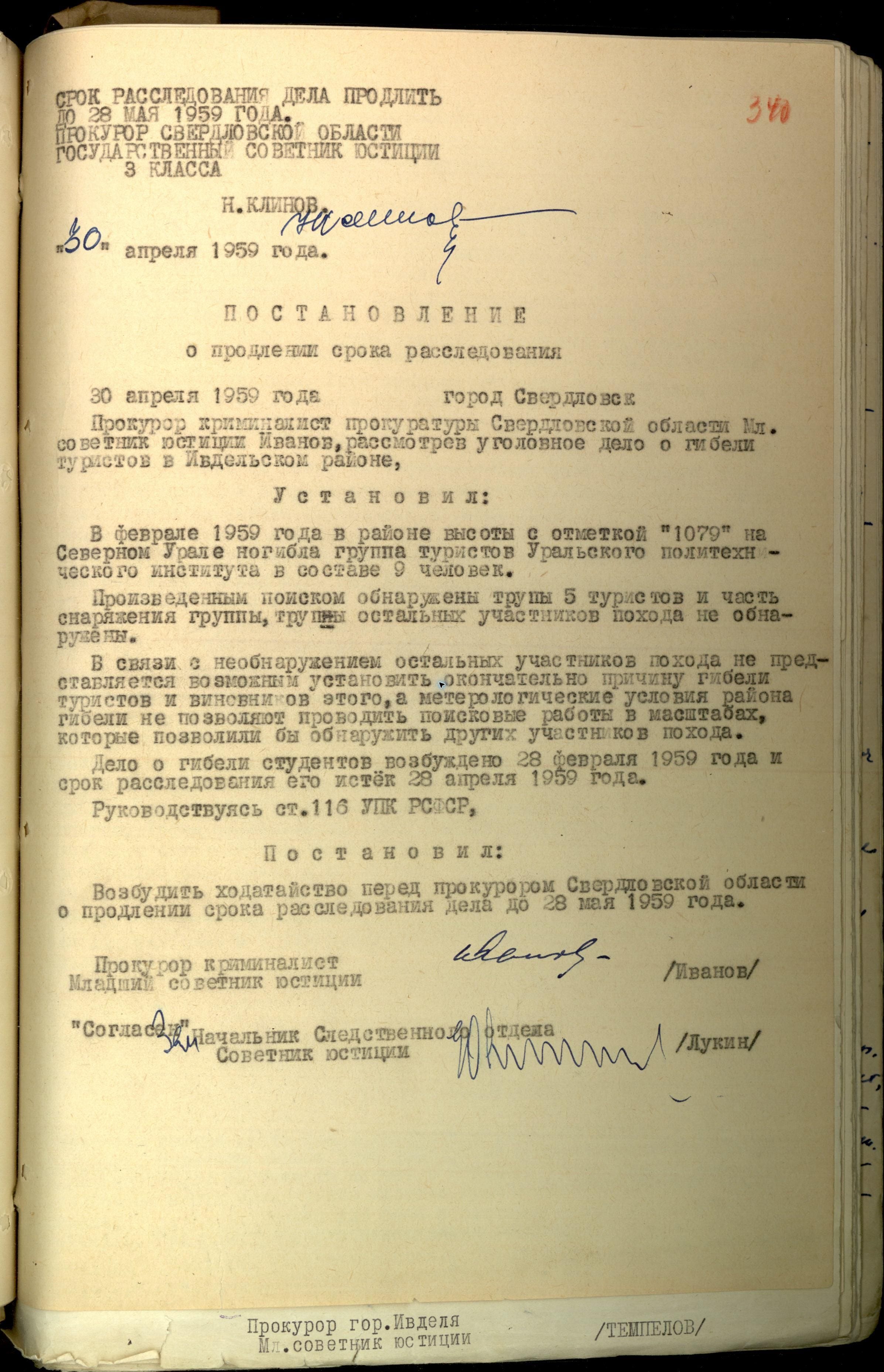
At the end of April, the investigation was still waiting for the last four people. Ivanov’s extension request states this plainly. He could not finally establish the circumstances while part of the group remained missing, and conditions were preventing the search from being carried out on the necessary scale. The paper is dated 30 April; the extension runs to 28 May, the date on the eventual closing resolution.
The discovery in early May did not bring the expected clarity. Dubinina, Zolotaryov, Nikolay Thibeaux-Brignolle and Aleksander Kolevatov were recovered in a ravine, beneath snow and in running water. The scene protocol of 6 May describes an urgent recovery because the current was strong. It also records a floor of cut branches upstream from the bodies.
The floor and the bodies were separate finds, about six metres apart in that account. The branch layer consisted of fourteen fir tops and one birch, with clothing on it. This is a useful correction to the compressed impression that the four were simply found underneath their shelter. The document leaves room for movement between the floor and the creek, or for changes in the snow around them, without telling us which occurred.
Clothing offers another incomplete sequence. Some garments associated with the two men at the cedar were found with or near the ravine group. Pieces had been cut. Dubinina’s recovered clothing included an improvised wrapping on a leg. The usual reading is that survivors took material from companions who had died and used it for warmth. It is a grim but understandable response to the position they were in. Precisely who cut each piece, who first wore it and when it changed hands cannot all be recovered.
The work around the cedar and ravine had taken place beyond the reach of the boots and equipment left uphill. No surviving note explains why the hikers stayed away from the tent for so long.
A light in the February sky
Vladislav Karelin, who later joined the search, was travelling with another ski party that February. His testimony records an unusual light seen on the morning of the 17th, roughly two weeks after the probable night of the deaths.
Someone preparing breakfast called the others outside. Karelin described a growing bright patch with a star-like centre, moving across the sky and disappearing beyond the mountain and forest. One companion was frightened. Karelin thought it was a large meteorite, although that was his impression rather than an established identification.
Karelin gave this account on 15 April, while four of the missing hikers were still being sought. The light had troubled some of his companions, but its date placed it well after the emergency at Dyatlov’s tent.
What went to the laboratory
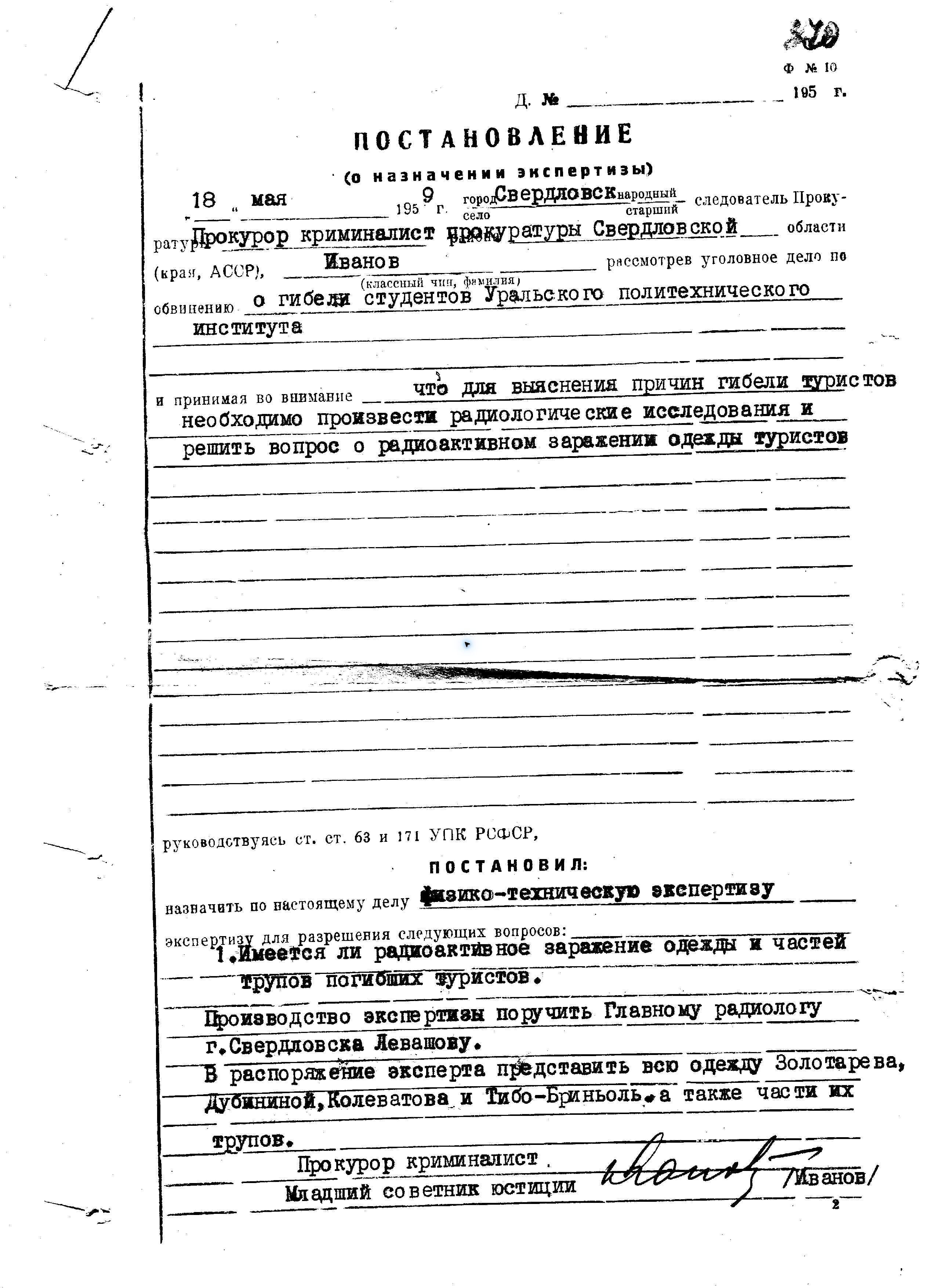
On 18 May, Ivanov ordered a radiological examination. The request concerned clothing and tissue from the four hikers recovered in the ravine. It asked whether radioactive contamination was present. The order survives, along with the laboratory report, so the radiation in the story cannot be dismissed as an invention added years later.
The results concerned particular areas of clothing. Elevated beta activity was measured, including on a brown sweater recovered from Dubinina and parts of clothing from Kolevatov. Washing samples under running water reduced their activity. The report treated this as contamination that could be washed off, rather than radioactivity induced throughout the material.
The tissue samples were assessed as within natural levels. The laboratory could not identify the contaminating substance: it lacked the equipment and conditions for the necessary analysis. A reference to strontium in the report describes a calibration preparation, not a successful identification of the isotope on the clothes.
This leaves a narrower, more difficult question than the popular image of nine radioactive bodies. Where had the affected garments encountered the material, and when? The report does not answer it. Work involving radioactive substances, environmental contamination and weapons-related explanations have all entered discussion. None can be assigned to these particular marks simply from the measurements that survive.
There is also a genuine archival complication. An annotation dated 10 July records that sheets 370–378 were removed to a special sector of the regional prosecutor’s office as irrelevant. Those papers include the radiological material and are available in the assembled archive today. The note shows that the documents were separated. It supplies neither a confession of a weapons accident nor a full explanation of the decision to remove them.
The injuries and the closing decision
The severe injuries to three of the ravine victims remain a major part of the case. Dubinina and Zolotaryov had extensive rib fractures. Thibeaux-Brignolle had a serious skull injury. Questioned later, the forensic expert Boris Vozrozhdenniy described the substantial force he thought necessary to produce the damage.
He compared the severity of Thibeaux-Brignolle’s injury with an impact from a fast-moving vehicle and discussed a fall against rocks or ice. For the chest injuries, he used the comparison of a bomb’s shock wave. He was describing the kind of force involved; he had not established that a bomb had exploded at the campsite.
He also judged that Thibeaux-Brignolle would have been unable to move independently after his injury. If that assessment is right, a reconstruction placing the injury at the tent has to account for his journey downhill, perhaps carried or dragged by his companions. Placing it in the ravine leaves another question: what struck or compressed him there?
Dubinina’s missing tongue is often detached from the rest of her autopsy. The report describes wider loss of facial tissue, absent eyes and signs of prolonged exposure to moisture and decomposition. It does not describe a neatly isolated surgical removal. The episode considers post-mortem processes as an explanation, and the condition recorded by the examiner gives that possibility a substantial basis. The chest fractures and the missing soft tissue should not automatically be treated as injuries inflicted in one act.
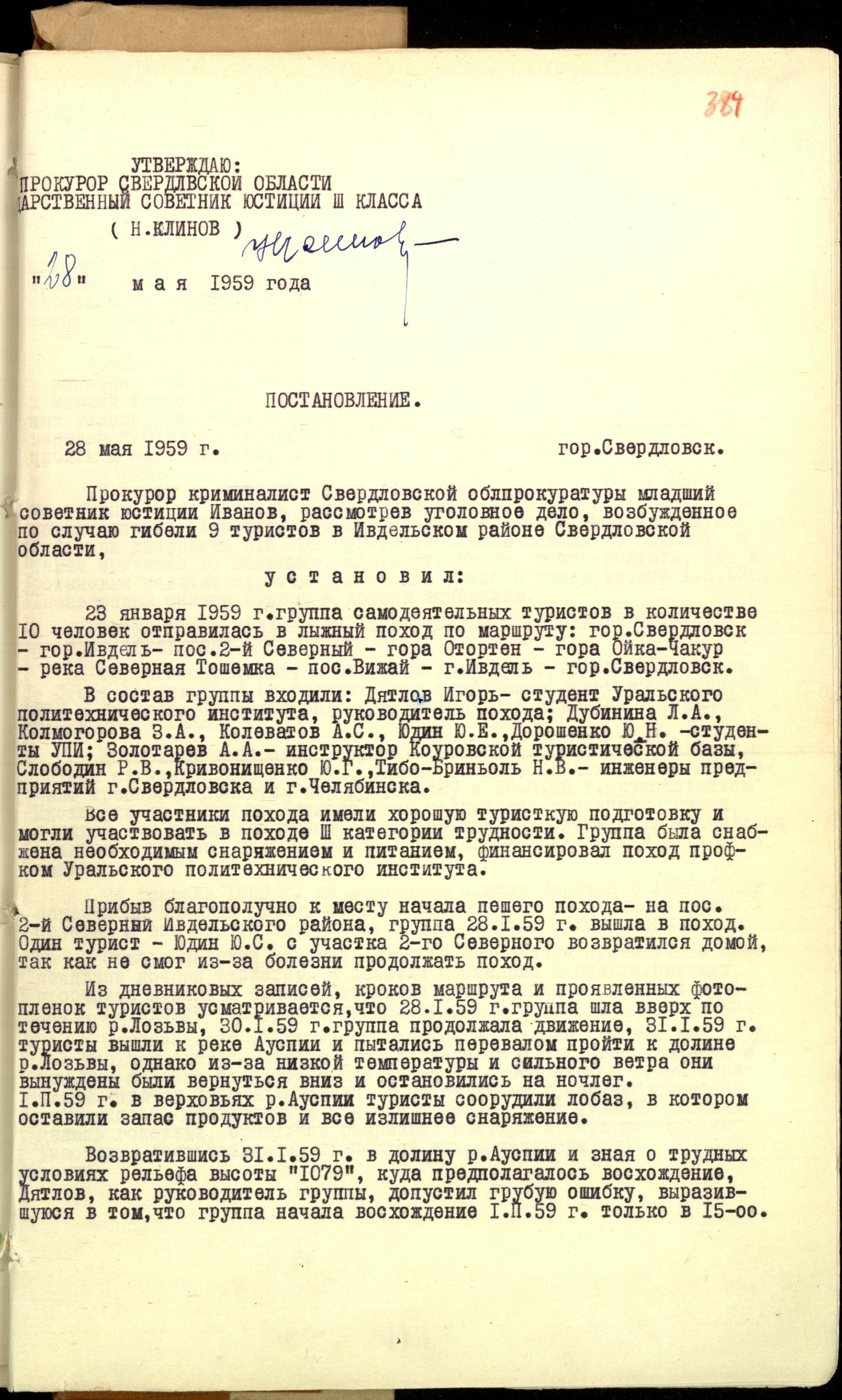
The closing resolution of 28 May assembled the route, the findings and the medical conclusions, then attributed the deaths to a force the hikers had been unable to overcome. English versions render the phrase differently; the familiar “compelling force” is not the name of a cause identified in the file.
The same document is less hesitant about institutional failures. It records disciplinary action against officials responsible for sporting arrangements, while saying that no causal connection had been established between those shortcomings and the deaths. The criminal proceedings were ended. The families were left with a conclusion broad enough to encompass very different events, and no witness who could describe the moment the group abandoned its shelter.
Snow on the eastern slopes
The avalanche explanation has changed since it first entered the argument. A large slide sweeping away the whole campsite is difficult to reconcile with what searchers described. The later scientific work instead examined a smaller slab breaking above the tent, after the party had cut into the snow to make a level place to sleep.
In January 2021, Johan Gaume and Alexander Puzrin published a model in which wind added snow above that cut until a weak layer failed. The delay mattered: the slab did not have to fall while the tent was being erected. Their calculations also explored whether a compact mass of snow could produce serious injuries. The work offered a physical mechanism for several contested details, using assumptions about a night whose exact conditions cannot now be measured.
The dates are easily muddled. The Russian prosecutor’s review began in 2019 and announced an avalanche conclusion in July 2020. Gaume and Puzrin’s paper appeared in 2021. Field observations discussed in their follow-up came later still. These were related contributions to the argument, not a single investigation whose computer model recreated the night as it actually happened.
A summer survey in 2021 used a drone to examine terrain near the possible tent locations. It found steeper steps beneath the broad slope, helping explain why the mountain could look too gentle when judged at a distance or when covered in snow. Winter expeditions also examined signs of snow movement nearby.
In January 2022, guides Dmitriy Borisov and Oleg Demyanenko documented two slab avalanches on an eastern slope less than three kilometres from the campsite. These were not traces preserved from 1959. They were evidence that avalanches could occur in the surrounding terrain. The researchers acknowledged differences between those events and the mechanism they had proposed for the tent.
The journeys themselves were difficult. EPFL’s account describes worsening weather that prevented the guides from completing planned tests. The photographs they did bring back joined the summer measurements, extending the argument beyond the photographs and estimates made during the original search.
The avalanche work answers objections that once seemed decisive, particularly the assumption that no such snow movement could occur nearby. A small slab is now a serious explanation for the departure from the tent. The movements in the forest still have to be reconstructed from the older evidence, including the branch floor and the clothing found away from its original wearers.
Below the ridge, in the Auspiya valley, the hikers had left another part of their camp for the return journey. Searchers opened the cache on 2 March and inventoried its provisions. The food was turned over for use as an emergency reserve by the search party. Other items were retained. On Ivanov’s list, after the food, come a mandolin and a pair of shoes with worn socks tucked inside.

The dates in the surviving record
23 January 1959
The shared diary begins with preparations in Sverdlovsk and the party’s departure. Entries follow the journey north through Serov, Ivdel and Vizhay.
Some later recollections give different travel dates; the diary provides a contemporary sequence.
28 January 1959
Yuri Yudin turns back from Second Northern because of pain in his leg. Nine members continue the ski expedition.
31 January 1959
The group encounters strong wind on higher ground and descends to camp in the Auspiya valley. Igor Dyatlov writes the last entry in the shared diary.
1–2 February 1959
The party leaves a supply cache and camps on the mountain slope. The deaths are generally placed during the night of 1–2 February.
The timing and sequence of the emergency are reconstructed, not supplied by a surviving eyewitness.
17 February 1959
Karelin’s separate ski party observes an unusual light in the morning sky. He later describes it to investigators.
This sighting took place after the probable night of the deaths.
26 February to early March 1959
Searchers find the tent, then recover five members of the party in the forest and on the slope. The supply cache is inventoried on 2 March.
Accounts differ on some recovery dates and details. Tent discovery and body recovery should not be collapsed into one event.
23 March and 16 April 1959
Kurikov gives his statement about the Mansi community on 23 March. The tent examiner’s report, dated 16 April, concludes that three cuts were made from inside.
30 April to 9 May 1959
The inquiry is extended while four hikers remain missing. They are found in early May; the ravine scene protocol is dated 6 May and the autopsies follow.
18–28 May 1959
Ivanov orders radiological testing on 18 May. The laboratory reports its findings later that month. The criminal investigation closes on 28 May.
2019–2020
The Russian prosecutor’s office undertakes a fresh review and announces an avalanche conclusion in July 2020.
2021–2022
Gaume and Puzrin publish their slab-avalanche model in January 2021. Subsequent expeditions examine the terrain and document avalanches nearby; a follow-up paper appears in 2022.
Sources and image credits
The episode and the voices on the journey
Midnight Signals, “Dyatlov Pass.” The companion follows the released episode, originally dated 3 March 2025. The full 23-minute narration was accessed through the automatic captions on the show’s matching YouTube release. Captions contain transcription errors, particularly in names; historical spellings and added details were checked against the records below.
The group diary, 23–31 January. The transcription and page facsimiles preserve changing contributors and practical concerns. Read the dated entries separately from the website’s later explanatory notes, which sometimes move ahead of the diary itself.
The individual diaries. Dubinina’s diary supplies the cinema visit and her impressions of travelling companions and workers. Kolmogorova’s diary adds the school visit and personal exchanges. These are particularly rewarding after hearing the episode: both women have more to say than the final search map can convey.
Yudin’s statement, 15 April. Case sheets 293–294 cover preparations, membership and his departure. His comments about Zolotaryov should be read alongside later suspicion surrounding the instructor.
Following the search through its papers
The tent’s discovery and examination. Read Slobtsov’s recollections, sheets 298–300, alongside the tent report, sheets 303–304 and accompanying photographs. They concern different stages of the inquiry. The illustrations attached to the examination show which damage the expert actually studied.
The Mansi witness. Kurikov’s statement, sheet 232, records direct answers about access to sacred ground and allegations of an attack. It should not be replaced by an unattributed account of what “the Mansi believed.”
The April extension and the May recovery. Sheet 340 explains why the investigation needed more time. The 6 May scene protocol, sheets 341–343, distinguishes the branch floor from the bodies in the creek. Distances in such descriptions are approximate. The recovery and medical records contain distressing details.
The February light. Karelin’s statement, sheets 290–292, is valuable for its date and differing reactions among witnesses. His personal interpretation and his later conjectures about the missing group are separate from what he saw.
The radiological material. The order and removal annotation should be read with the laboratory findings, sheets 371–377. Follow the distinction between clothing contamination and tissue measurements. The report leaves the contaminating substance unidentified.
Medical findings and closure. Dubinina’s autopsy, sheets 355–357, and the expert’s questioning, sheets 381–383, describe different kinds of damage. The closing resolution, sheets 384–387, brings together findings and official judgments; those judgments should not all be treated as direct observations.
The return supplies. The 2 March cache inventory, sheets 8–10, lists provisions and other equipment. The mandolin appears among the items retained after food was allocated to the search party.
The DyatlovPass.com collection, maintained by Teodora Hadjiyska, is a privately assembled resource containing Russian facsimiles, English translations and later commentary. The contemporary documents are the sources used here; the site’s theories are not adopted wholesale. Transliteration and English wording vary. This companion paraphrases the evidence and does not offer a certified translation of the file.
Later research and viewing
Gaume and Puzrin, 2021. “Mechanisms of slab avalanche release and impact in the Dyatlov Pass incident in 1959” presents the physical model. Its diagrams make the proposed slope cut and delayed failure easier to follow; they depict a hypothesis rather than an observed reconstruction.
Gaume and Puzrin, 2022. “Post-publication careers: follow-up expeditions reveal avalanches at Dyatlov Pass” describes the terrain survey and subsequent observations. Its supplementary films show the nearby snow instabilities. The final discussion identifies differences from the proposed 1959 event.
The expeditions on film. EPFL’s account of 24 March 2022 includes expedition footage and links to Matteo Born’s RSI documentary, Il mistero Dyatlov. It is a useful route into the later fieldwork; the commentary comes from the institution involved in that research.
Image credits
The three illustrations are complete page facsimiles of official investigation documents. Each was reproduced from its full-resolution archival scan without removing any part of the page. They show the documents themselves, not a reconstruction of the campsite. Full-size individual PNGs accompany this article.
1. Resolution closing the investigation, first page, 28 May 1959. Creator: Lev Nikitich Ivanov, Sverdlovsk regional prosecutor-criminalist; approval appears at the head of the document. Case volume 1, sheet 384. Wikimedia Commons item, scan source and rights statement. The item identifies the complete official legal document as public domain under the Russian official-documents exclusion, PD-RU-exempt.

2. Request to extend the investigation, 30 April 1959. Creator: Lev Nikitich Ivanov, with official approvals. Case volume 1, sheet 340. Wikimedia Commons item, scan source and rights statement. Public-domain basis: PD-RU-exempt, official legal document. The page is reproduced in full.

3. Order for radiological examination, 18 May 1959. Creator: Lev Nikitich Ivanov. Case volume 1, sheet 370. Wikimedia Commons item, scan source and rights statement. Public-domain basis: PD-RU-exempt, official legal document. The page is reproduced in full.
