


This guide lists what the documents and studies show about the Moberly and Jourdain account of the Petit Trianon, in date order, with a source on every entry.
Listen to the episode: Echoes of Versailles
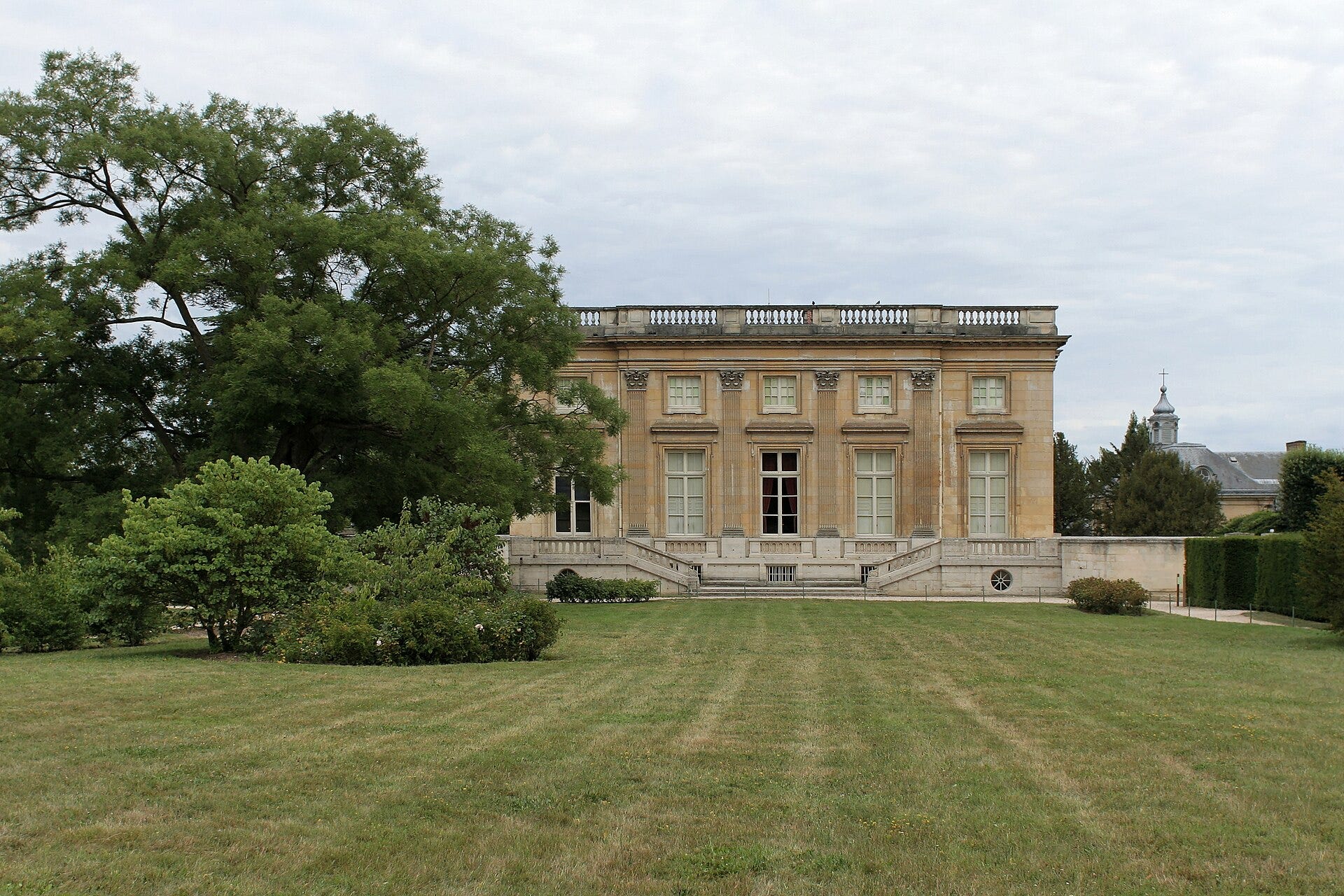
The Petit Trianon, north front, seen from the English garden. Photo: Coyau, CC BY-SA 3.0, via Wikimedia Commons.
At a glance
The walk: Saturday, 10 August 1901, the gardens of the Petit Trianon, Versailles
The witnesses: Charlotte Anne Moberly, principal of St Hugh’s Hall, Oxford, and Eleanor Jourdain, later her vice-principal
The book: An Adventure, London, Macmillan, January 1911, signed “Elizabeth Morison” and “Frances Lamont”
The record: Their own written accounts, the earliest dated November 1901 [1]
The walk, August 1901
10 August 1901. Versailles. According to the account Moberly wrote in November 1901, she and Jourdain went to Versailles from Paris, and it was “nearly four o’clock in the afternoon” when they left the Palace to find the Petit Trianon. They followed Baedeker’s plan and, by their own account, lost their way. [1] [3]
The same afternoon. What they reported. In An Adventure they wrote of a woman shaking a white cloth from a window, two men in long coats and three-cornered hats whom Moberly called “very dignified officials,” a garden kiosk with a cloaked man beside it, and a sudden change in the air. Moberly wrote: “It was all intensely still.” [1]
The same afternoon. The lady on the grass. Moberly wrote that a lady was sitting near the terrace, “holding out a paper as though to look at it at arm’s length,” in “a shady white hat.” Jourdain later said she had seen no lady. [1] [3]
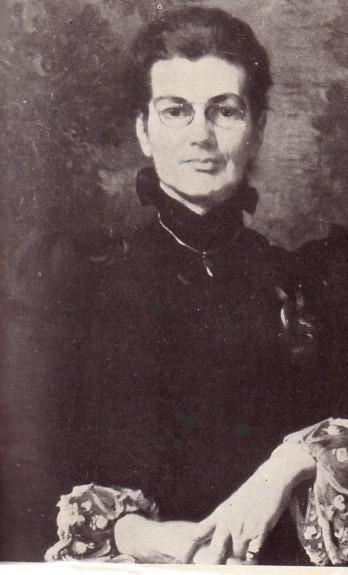
Charlotte Anne Moberly (1846 to 1937). Unknown author. Public domain, via Wikimedia Commons.
Writing it down, 1901 to 1902
About a week later. The letter. Moberly wrote that neither spoke of the afternoon for a week. Writing a letter about the trip, she asked Jourdain, “Do you think that the Petit Trianon is haunted?” She recorded the answer as “Yes, I do.” [1] [3]
10 November 1901. Comparing notes. Three months later, in Oxford, Moberly mentioned the lady sketching. According to An Adventure, Jourdain “replied that she had seen no lady.” [1] [3]
November and December 1901. The first accounts. The 1913 appendix prints two short accounts, one by each woman, dated 25 and 28 November 1901. Two longer versions, dated November and December 1901, were copied into a manuscript book in 1906 “and then destroyed.” [1]
2 January 1902. A second visit. Jourdain went back alone. She wrote that the Temple de l’Amour “was not the building we had passed in the summer.” [1]
October 1902. The Society for Psychical Research. A footnote in the 1913 edition says the two short accounts were sent to the Society in October 1902, “before any investigations began.” [1]
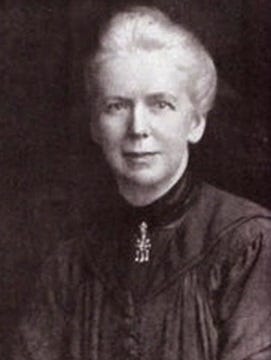
Eleanor Jourdain (1863 to 1924). Unknown author. Public domain, via Wikimedia Commons.
Return visits and research, 1903 to 1910
1903. An old map. An old map of the Trianon gardens was found that showed a bridge the women said they had crossed. [3]
4 and 9 July 1904. Back together. Moberly wrote of the return: “The kiosk was gone; so was the ravine and the little cascade.” [1]
1904 to 1910. The research. The appendix says nearly forty people later wrote testimonies that they had been told the story, dated from October 1902 to September 1910, and that “the larger number of the corroborative data came to light after 1906.” It adds that Jourdain checked the municipal list of fêtes at Versailles and found one in Louis XVI costume in June 1901, confined to the Hameau, and none in August 1901. [1]
The book and its editions, 1911 to 1955
January 1911. An Adventure. Macmillan published the book under the names Elizabeth Morison and Frances Lamont. The publishers’ note says the signatures “are the only fictitious words in the book.” It was reprinted twice in February 1911, again in March, April and July 1911, and in 1912. [1] [2]
June 1911. The first review. Eleanor Sidgwick reviewed the book, unsigned, in a supplement to the Proceedings of the Society for Psychical Research. She suggested that the women had misinterpreted normal events. [3]
1913. Second edition. A second edition added an appendix and maps, and was reprinted the same year. [1]
1924, 1931, 1955. Further editions followed. The authors’ identity was made public in 1931. The 1955 edition was edited by the art historian Joan Evans, Jourdain’s literary executor. [3] [4] [6] [7]
What was tested
1950. W. H. Salter. Salter’s “An Adventure: A Note on the Evidence” appeared in the Journal of the Society for Psychical Research. Skeptoid summarizes his point that the embellished versions were written well after the dates the women gave, and after their return visits. [3] [4]
1965. Philippe Jullian. In his biography of the poet Robert de Montesquiou, Jullian proposed that the women had walked into a costumed gathering of Montesquiou’s friends, who staged tableaux vivants. Skeptoid notes that no evidence survives that Montesquiou held such an event in 1901. [3] [4] [8]
1976. Joan Evans. In the magazine Encounter, Evans set out the costumed-gathering explanation, drawing on Jullian. As copyright holder she accepted that solution and forbade further editions. [3] [4] [8]
1988. Michael Coleman. Comparing the November 1901 accounts with the published text, Coleman concluded that the book had been considerably enlarged after the research began, and that the early accounts had little or nothing to suggest a supernatural experience. [3]
1991. Terry Castle. “Contagious Folly: ‘An Adventure’ and Its Skeptics,” in Critical Inquiry, reviewed the case and the public reaction. [5] [3]
Theories and open questions
A costumed party. The Jullian and Evans reading. Evans found no recorded event matching the 1901 visit. [4]
Misreading and memory. Sidgwick suggested normal events misread. Salter and Coleman pointed to an account that grew as the women researched and retold it. The psychologist Leonard Zusne suggested a hallucinatory experience embellished over time. [3] [4]
A shared delusion. Some writers proposed a folie à deux between the two women. Castle noted that idea with skepticism and concluded that a core of mystery remains. [3] [5]
Still unknown. Exactly what the two women saw that afternoon, and how much of the published account dates from 1901. [3] [4]
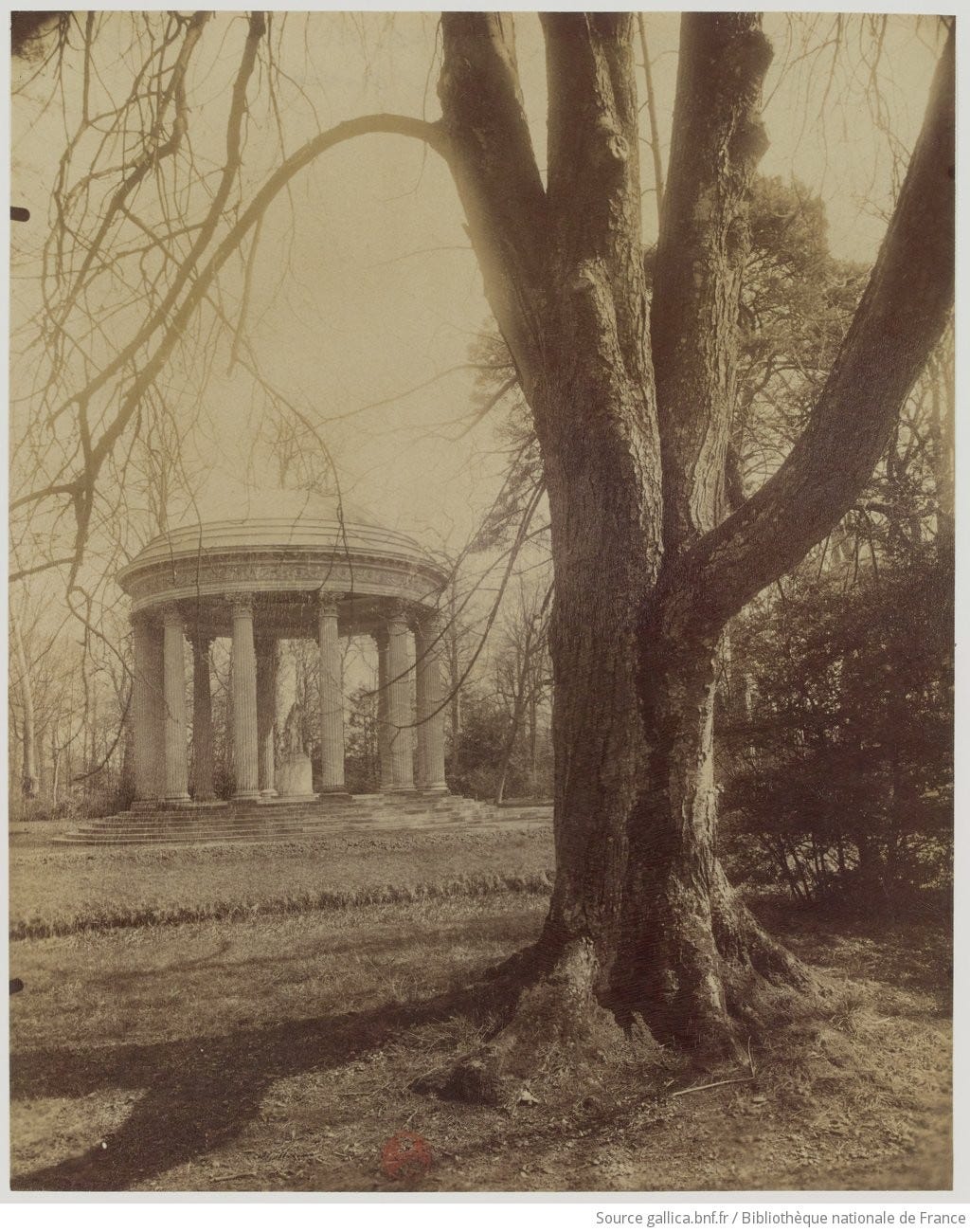
The Temple de l’Amour, Petit Trianon. Photo: Eugène Atget, undated. Bibliothèque nationale de France. Public domain, via Wikimedia Commons.
The places
The Petit Trianon. Built between 1762 and 1768. Louis XVI gave it to Marie Antoinette in 1774. [9]
The English garden, north side. Where Moberly placed the lady sketching, beside the terrace. [1]
The Temple de l’Amour. A garden folly by Richard Mique, erected in 1778. Jourdain wrote that it was not the building they passed. [1] [9] [10]
The Belvedere. An octagonal music pavilion by Mique, built 1778 to 1781, beside an artificial rock and a small lake, restored in 2012. Moberly wrote that the bridge near it “had no resemblance” to the one they remembered. [1] [11]
The Hameau de la Reine. The queen’s hamlet, built from 1783 to 1786. Site of the June 1901 costumed fête. [1] [12]
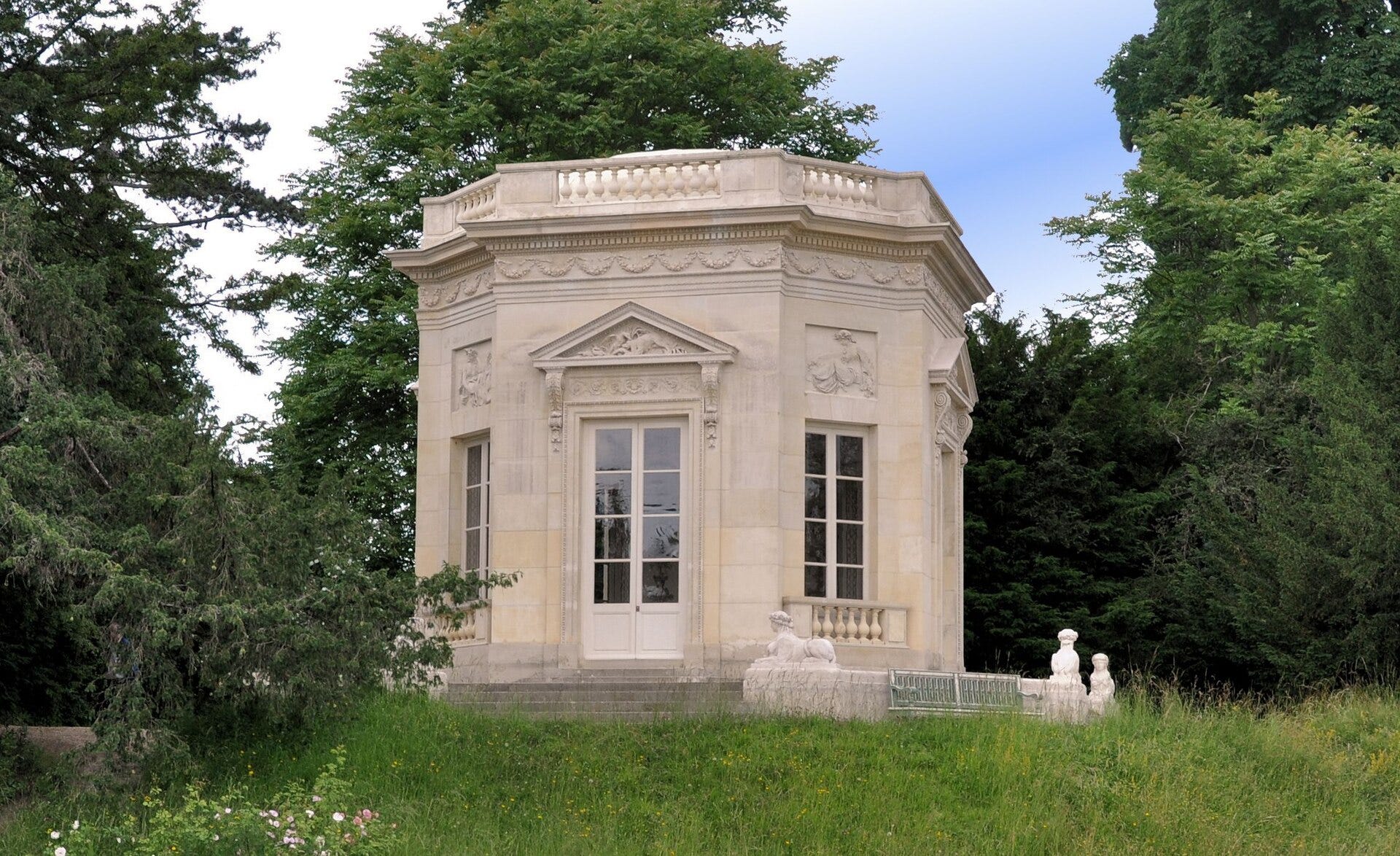
The Belvedere, Petit Trianon. Photo: Starus, CC BY-SA 3.0, via Wikimedia Commons.
Questions
Who were “Elizabeth Morison” and “Frances Lamont”? Charlotte Anne Moberly, first principal of St Hugh’s, Oxford, and Eleanor Jourdain, who succeeded her as principal in 1915. [6] [7] Their names were made public in 1931. [3]
Did they claim to see Marie Antoinette? Moberly came to believe that the lady sketching was the queen. Jourdain did not see the lady. [1] [3]
What did the Society for Psychical Research conclude? Sidgwick’s 1911 review suggested normal events misread. Salter’s 1950 note found the evidence too weak for further study. [3] [4]
Can I read the original book? Yes. Scans of the 1911 first edition and the 1913 second edition are freely available. [1] [2]
Where are they buried? In Wolvercote Cemetery, Oxford, a few feet apart. [13]
Listen
The full story is in the episode: Echoes of Versailles
Sources
Moberly, C. A. E. and Jourdain, E. F. (”Elizabeth Morison” and “Frances Lamont”). An Adventure, with Appendix and Maps, second edition. London: Macmillan, 1913. Internet Archive. archive.org/details/adventurewithapp00mobe
An Adventure, first edition, 1911. Scan, Wikimedia Commons. commons.wikimedia.org
Wikipedia, “Moberly-Jourdain incident” (accessed Oct 27, 2026). en.wikipedia.org/wiki/Moberly-Jourdain_incident
Dunning, B. “The Versailles Time Slip.” Skeptoid, episode 296, 7 February 2012. skeptoid.com/episodes/4296
Castle, T. (1991). “Contagious Folly: ‘An Adventure’ and Its Skeptics.” Critical Inquiry 17(4), 741 to 772. doi.org/10.1086/448611
Wikipedia, “Charlotte Anne Moberly” (accessed Oct 27, 2026). en.wikipedia.org/wiki/Charlotte_Anne_Moberly
Wikipedia, “Eleanor Jourdain” (accessed Oct 27, 2026). en.wikipedia.org/wiki/Eleanor_Jourdain
Wikipedia, “Robert de Montesquiou” (accessed Oct 27, 2026). en.wikipedia.org/wiki/Robert_de_Montesquiou
Wikipedia, “Petit Trianon” (accessed Oct 27, 2026). en.wikipedia.org/wiki/Petit_Trianon
Wikipedia, “Temple de l’Amour” (accessed Oct 27, 2026). en.wikipedia.org/wiki/Temple_de_l’Amour
Wikipedia, “Belvédère (Petit Trianon)” (accessed Oct 27, 2026). en.wikipedia.org/wiki/Belvédère_(Petit_Trianon)
Wikipedia, “Hameau de la Reine” (accessed Oct 27, 2026). en.wikipedia.org/wiki/Hameau_de_la_Reine
Wheatley, C. “The Respected Oxford Professors Who Say They Time Traveled.” Atlas Obscura, 12 March 2024. atlasobscura.com
Image credits
Petit Trianon, north front. Photo: Coyau, 2011, CC BY-SA 3.0. Wikimedia Commons
Charlotte Anne Moberly. Unknown author. Public domain. Wikimedia Commons
Eleanor Jourdain. Unknown author. Public domain. Wikimedia Commons
Temple de l’Amour, Petit Trianon. Photo: Eugène Atget, undated. Bibliothèque nationale de France (Gallica). Public domain. Wikimedia Commons
The Belvedere, Petit Trianon. Photo: Starus, 2013, CC BY-SA 3.0. Wikimedia Commons


