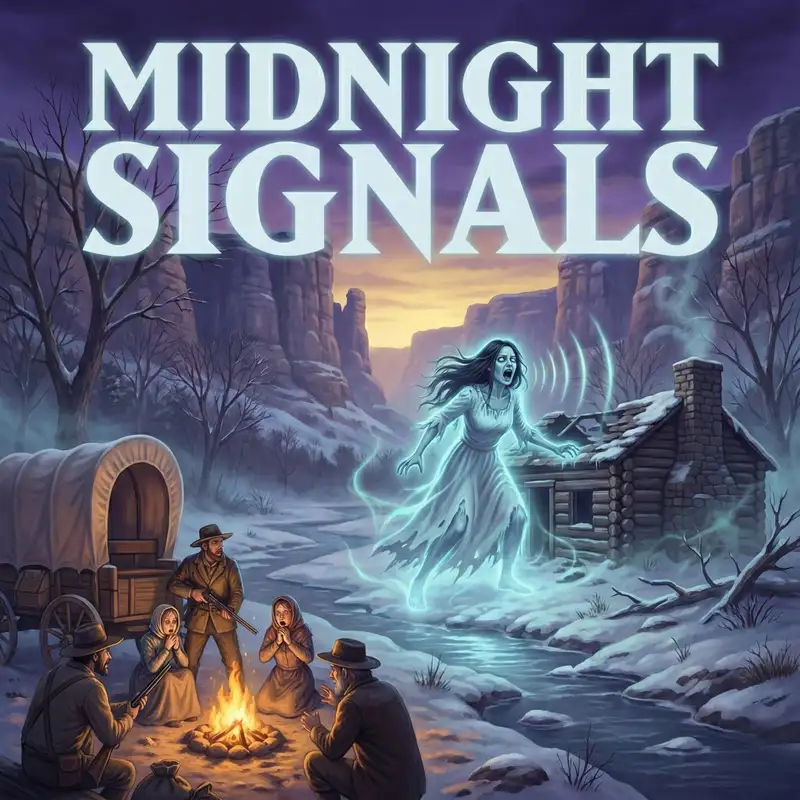
50 States of Folklore - Nebraska: The Rawhide Creek Fable
The piercing screams shattered the prairie silence just as the sun dipped behind the canyon walls. Wagon train families huddled closer to their fires, children pressed against their mothers' skirts, while seasoned frontiersmen reached instinctively for their rifles. The sound echoed off the limestone bluffs of Ash Hollow, that crucial stopping point along the Oregon Trail in Western Nebraska where thousands of pioneers had found refuge. But on this evening in 1847, refuge felt like a distant memory. Something moved in the gathering darkness between the cottonwood trees.
Speaker 1:Something that would transform this vital frontier crossroads into one of the most haunted locations in the American West. Ash Hollow represented salvation to countless pioneer families making the grueling journey west across the Nebraska Territory. After days of struggling across the barren landscape north of the South Platte River, where alkaline water poisoned livestock and sparse grass left animals weak and stumbling, the sight of this natural depression in the earth meant the difference between life and death. The hollow promised the first reliable fresh water and abundant grazing in over a 100 miles of harsh travel. The descent into Ash Hollow tested every wagon and every family.
Speaker 1:Pioneer diaries described the treacherous slope that dropped nearly 200 feet in less than a mile, forcing travelers to lock their wagon wheels and use ropes to control their descent. Women walked alongside their children while men struggled to keep their overloaded wagons from careening out of control down the rocky incline. The sound of splintering wood and shouting voices echoed constantly as families navigated what many called the most dangerous part of their entire journey. But once safely at the bottom, the hollow revealed itself as a frontier oasis. Crystal clear springs bubbled up from the limestone bedrock, creating Ash Creek that wound through groves of ash and cottonwood trees.
Speaker 1:The grass grew thick and green, providing the first quality forage for exhausted oxen and horses in weeks. Pioneer women could finally wash clothes in clean water while their children played safely in the shade of ancient trees that had sheltered travelers for generations before the wagon trains arrived. The natural geography created a bottleneck where multiple trails converged. The Oregon Trail, the California Trail, and various cutoffs all funneled through this single passage, creating a temporary city that appeared and disappeared with the rhythm of westward migration. During peak travel months, dozens of wagon trains might occupy the hollow simultaneously, their white canvas tops scattered across the valley floor like a sea of prairie schooners anchored in a green harbor.
Speaker 1:A trading post established near the springs became the commercial heart of this temporary community. The proprietor, a weathered frontiersman named Samuel Morrison, had recognized the potential of this natural stopping point and built a sturdy log structure that served as store, saloon, and informal post office. Pioneer families could purchase supplies, trade worn out equipment, and gather precious information about the trail ahead. Morrison's post attracted not just wagon train families but also fur traders, military scouts, local ranchers, and Native Americans who came to trade. The diversity of people passing through Ash Hollow created a unique frontier melting pot.
Speaker 1:Families from Missouri farmland shared campfires with German immigrants, while Mormon pioneers traveling to Utah exchanged stories with gold seekers bound for California. Professional guides shared their knowledge with amateur adventurers, and experienced travelers warned newcomers about the challenges waiting ahead. The hollow buzzed with multiple languages, the sounds of children playing, livestock grazing, and the constant activity of people preparing for the next leg of their journey. This sense of community and temporary safety made Ash Hollow feel almost civilized compared to the isolation of the open prairie. Families could let their guard down for a few precious days, allowing children to explore and play while adults tended to necessary repairs and preparations.
Speaker 1:The abundance of fresh water meant hot meals and clean clothes, luxuries that had become distant memories during the harsh crossing of Central Nebraska. Evening gatherings around communal fires became social events where travelers shared news from back east, compared notes about trail conditions, and told stories to pass the long prairie nights. Musicians brought out fiddles and harmonicas, creating impromptu concerts under the vast Nebraska sky. Young people found romance, families made lasting friendships, and the bonds of shared hardship created connections that would endure long after the trails divided and sent people to their separate destinations. The natural protection offered by the canyon walls created an illusion of security that contrasted sharply with the exposed vulnerability of prairie travel.
Speaker 1:Families could spread out their belongings without fear of sudden storms or hostile encounters. The reliable water source meant they could take time to properly care for sick family members or injured animals without the pressure of finding the next waterhole. This atmosphere of safety and community made what happened next even more terrifying. In a place where thousands of people had found refuge and renewal, where families felt secure enough to let down their guard, the appearance of something that defied explanation would transform Ash Hollow from a symbol of hope into a reminder that the frontier held mysteries far darker than anything the civilized world had prepared them for. The first documented sighting occurred on a September evening in 1847, recorded in the Journal of Wagon Master Thomas Whitmore as his train prepared to leave Ash Hollow after a three day rest.
Speaker 1:Whitmore described watching a figure emerge from the Cottonwood Grove near the old cabin ruins, just as twilight painted the canyon walls purple and gold. At first glance she appeared to be another traveler, perhaps a woman from one of the other wagon trains scattered throughout the hollow. But something about her movement caught his attention. She walked with an unnatural gait, not the purposeful stride of someone heading to a specific destination, but the wandering, searching motion of someone hopelessly lost. Her white dress, which Whitmore initially assumed was a traveling outfit, seemed to glow with its own pale light as darkness gathered around her.
Speaker 1:When he called out a greeting, she showed no sign of hearing him, continuing her strange, aimless journey through the gathering shadows. Within weeks, similar accounts began appearing in pioneer diaries and letters sent back east. The Miller family, traveling with a Mormon wagon train bound for Utah, wrote of seeing the same woman three nights running. She appeared always at the same time, just as the sun disappeared behind the western rim of the hollow, and always in the same general area near what locals had begun calling the old cabin site. Mary Miller described her as wearing a tattered white dress that might once have been a wedding gown or burial shroud, her long dark hair hanging loose and uncombed around her shoulders.
Speaker 1:The woman's behavior followed a consistent pattern that witnesses found deeply disturbing. She would appear near the cabin ruins and begin what could only be described as a desperate search. She moved from tree to tree, peering behind rocks and fallen logs, her hands reaching out as if grasping for something just beyond her reach. Her head turned constantly, scanning the landscape with an intensity that suggested she was looking for something specific, something precious that she had lost and must find. But it was her voice that transformed curious sightings into tales of terror that spread from wagon train to wagon train across the entire Oregon Trail network.
Speaker 1:The screaming began shortly after her appearance, piercing wails that echoed off the limestone canyon walls and seemed to come from everywhere and nowhere at once. The sound defied description in the limited vocabulary of frontier correspondence, but witnesses consistently described it as the most heartbreaking cry of anguish they had ever heard. Pioneer children who heard the screams would press their faces into their mothers' skirts and refused to be comforted. Seasoned frontiersmen who had faced down grizzly bears and hostile war parties found themselves reaching for weapons against an enemy they could not fight. The sound seemed to penetrate not just the ears, but something deeper, touching a primal fear that civilization had tried to bury but never quite eliminated.
Speaker 1:James Crawford, a trader who made regular trips through Ash Hollow, documented multiple encounters with the woman over a period of several months. His accounts provide the most detailed description of her appearance and behavior. He described her as appearing to be in her twenties, with features that suggested Native American heritage mixed with European ancestry. Her white dress, which he observed closely during one particularly clear evening, showed signs of having once been finely made but now hung in tatters, stained with what looked like mud or something darker. Crawford noted that she never seemed to see the living people around her, walking through campsites as if the wagons, fires, and families simply did not exist.
Speaker 1:Animals, however, reacted strongly to her presence. Horses would rear and pull against their tethers, their eyes rolling white with terror. Dogs that normally barked at any stranger would fall silent and slink away, tails tucked between their legs. Even the oxen, normally placid creatures, would low nervously and cluster together whenever she appeared. The woman's searching became more frantic as her appearances continued.
Speaker 1:Witnesses described her pawing at the ground near the cabin ruins, as if trying to dig with her bare hands. She would call out in a voice that carried clearly across the hollow, speaking words that sounded like a name repeated over and over, though the exact syllables remained unclear to English speaking ears. Some travelers familiar with native languages thought they detected Lakota words, while others insisted she spoke in English with an accent they could not identify. Early theories among the wagon train families ranged from the practical to the supernatural. Some believed she was simply a woman who had become separated from her family and lost her mind from exposure and grief.
Speaker 1:Others whispered that she might be the ghost of a pioneer woman who had died in the Hollow, doomed to search eternally for her lost family. A few suggested she might be something far older and more dangerous, a spirit that had haunted this place long before the first white settlers arrived. The growing reputation of the Screaming Woman began to change how travelers approached Ash Hollow. Wagon masters who had previously looked forward to the rest, stopped now and found themselves debating whether the benefits of fresh water and grass were worth the psychological toll on their families. Some trains began timing their arrival to leave before sunset, while others posted extra guards and kept fires burning bright throughout the night.
Speaker 1:The sense of safety and community that had made Ash Hollow special was slowly being replaced by an atmosphere of dread and watchful tension. The truth behind the screaming woman remained hidden until the winter of eighteen forty nine, when a Lakota elder named White Buffalo Calf shared the story with a missionary who had come to trade at Ash Hollow. The missionary, Father Benedict Kowalski, had been documenting Native American oral histories and was struck by the elder's willingness to speak about what he called the woman who searches for her heart. White Buffalo Calf explained that his people had known of the tragedy for years, but had not shared it with white travelers, believing that some sorrows were too sacred to speak aloud to strangers. According to White Buffalo Calf, the woman had been known among his people as Morning Star, though that was not the name her white husband had called her.
Speaker 1:She had been born to a Lakota mother and French trader father sometime in the early 1820s. Growing up between two worlds in the complex social landscape of the fur trade frontier. Her mixed heritage made her valuable as an interpreter and cultural bridge, skills that brought her to the attention of a young American trader named Robert Henley, who had established himself at Ash Hollow in the mid-1840s. Henley had arrived in Nebraska Territory with ambitious plans to capitalize on the growing wagon train traffic. Unlike the temporary trading posts that appeared and disappeared with the seasons, he intended to build a permanent operation that could serve the thousands of travelers who passed through the hollow each year.
Speaker 1:He constructed a sturdy log cabin near the springs, complete with a stone chimney and glass windows hauled at great expense from St. Louis. The cabin served as both his residence and business headquarters, a symbol of his commitment to making Ash Hollow his permanent home. Morningstar had initially worked for Henley as an interpreter, helping him communicate with the various Native American groups who came to trade, But their professional relationship quickly developed into something deeper. White Buffalo Calf described her as a woman of unusual beauty and intelligence, equally comfortable negotiating with Lakota chiefs or serving tea to pioneer women in her husband's cabin.
Speaker 1:The marriage that followed was celebrated by both the local native community and the white traders who recognized the political and economic advantages of such a union. For two years, the couple prospered together at Ash Hollow. Morning Star proved invaluable in establishing peaceful relationships with the various tribes whose territories bordered the Hollow, while Henley's business grew as word spread about his fair dealing and his wife's skill in resolving cultural misunderstandings. Their cabin became known as a place where different peoples could meet on neutral ground, where disputes could be settled and alliances forged over shared meals and honest conversation. The birth of their daughter in the spring of eighteen forty eight seemed to complete their happiness.
Speaker 1:The child, whom they named Sarah but who was known among the Lakota as Little Morning Star, represented the future that both parents hoped for, a generation that could bridge the gap between the rapidly changing worlds of Native America and white settlement. Pioneer women passing through Ash Hollow often commented on the beautiful child and her devoted parents, noting in their diaries how Morning Star would carry her daughter on her back while conducting business, singing traditional Lakota lullabies that echoed softly through the hollow. But prosperity and the frontier economy required constant movement and risk taking. In the autumn of eighteen forty eight, Henley received word that a valuable shipment of trade goods had arrived at Fort Laramie, 200 miles to the west. The goods included items specifically requested by his Native American trading partners: quality blankets, steel knives, and glass beads that would be essential for maintaining his relationships through the coming winter.
Speaker 1:He promised Morning Star that he would return within two moons, well before the heavy snows that could make travel impossible. Morning Star had begged to accompany him, as she had on previous trading expeditions, but the baby was too young for such a dangerous journey in late autumn weather. Henley assured her that the cabin was well stocked with supplies and that the local Lakota families would check on her regularly. He left in early November with two hired men and a pack train loaded with furs and trade items, expecting to complete his business and return before Christmas. The winter of eighteen forty eight to 1849 proved to be one of the most brutal in memory.
Speaker 1:Snow began falling in late November and continued almost without pause through February. Temperatures dropped so low that even the springs at Ash Hollow began to freeze, something local Native Americans said they had never seen before. The usual network of communication and mutual support that connected scattered frontier settlements broke down completely as everyone focused simply on survival. Morning Star waited through December, then January, watching the trail to the west for any sign of her husband's return. The local Lakota families, struggling with their own survival in the unprecedented cold, were unable to provide the regular support they had promised.
Speaker 1:The cabin's supplies, which had seemed adequate for a normal winter, dwindled steadily as the cold dragged on and no relief appeared. By February, both mother and child were showing signs of malnutrition and exposure. Morning Star had burned most of the cabin's furniture to keep the fire going, and her desperate searches for food had taken her farther and farther from the safety of her home. White Buffalo Calf's people found evidence that she had tried to reach their winter camp, following the frozen creek bed in the deep snow, but had been forced to turn back when the baby became too weak to travel. The final tragedy came in early March, just as the weather began to break.
Speaker 1:A Lakota hunting party, venturing out after the worst of the storms had passed, found the cabin door standing open and both mother and child frozen inside. Morning Star had wrapped her daughter in every blanket and piece of clothing she could find, holding her close in a final desperate attempt to share whatever warmth remained in her own failing body. They had died together, facing the window that looked west toward the trail where Robert Henley would eventually return to find his dreams transformed into a nightmare that would echo through Ash Hollow for generations to come. The discovery of Morning Star's tragic fate should have brought closure to the mystery of the screaming woman, but instead it seemed to intensify the supernatural activity at Ash Hollow. Word of the true story spread quickly through the network of traders, missionaries, and tribal communities that connected the scattered settlements of the Nebraska territory.
Speaker 1:Rather than diminishing the reports of ghostly encounters, knowledge of the tragedy appeared to make the apparitions more frequent and more disturbing. Wagon trained families who had heard the story found themselves watching for the woman with a mixture of sympathy and terror. Pioneer women, many of whom were mothers themselves, felt a deep connection to Morningstar's desperate search for help that never came. They understood the particular horror of watching a child suffer while being powerless to provide relief. This emotional resonance seemed to make their encounters with the spirit more vivid and more personal than the earlier, more distant sightings.
Speaker 1:The physical description of the apparition became remarkably consistent across multiple witness accounts. She appeared as a young woman in her twenties, her long black hair hanging loose and tangled around her shoulders. The white dress that had puzzled earlier observers now made tragic sense. It was her burial dress, the garment in which the Lakota had wrapped her body according to their customs before laying her to rest in the hills above the hollow. The dress showed signs of the ordeal she had endured, torn and stained from her desperate searches through the winter landscape.
Speaker 1:Her face carried an expression that witnesses found impossible to forget. Pioneer children who glimpsed her would wake screaming from nightmares for weeks afterward, describing eyes that held a pain so deep it seemed to reach across the boundary between life and death. Adult observers noted that her features showed clear signs of her mixed heritage. The high cheekbones and bronze skin that had made her such an effective cultural bridge in life now marking her as forever caught between worlds and death. The pattern of her appearances became more predictable as more travelers documented their encounters.
Speaker 1:She manifested most often during the hour just after sunset, when the canyon walls cast long shadows across the hollow floor. The temperature would drop noticeably in her vicinity, even during the warm summer months when the prairie air hung heavy and still. Campfires would flicker and dim as she passed, as if her presence drew warmth and light from the world of the living. Her searching behavior grew more frantic and specific as witnesses observed her night after night. She would appear near the ruins of the cabin where she had died, her hands reaching out as if trying to grasp something just beyond her reach.
Speaker 1:Travelers who watched closely realized she was not searching randomly but following a specific pattern, retracing the same desperate route she had taken during that final winter. She would move toward the creek bed where she had tried to reach the Lakota Winter Camp, then return to pace the area around the cabin, calling out in a voice that carried clearly across the hollow. The name she called became clearer to listeners who knew her story. Sarah, she would cry, using the English name her husband had given their daughter, followed by what sounded like Little Morning Star in Lakota. The anguish in her voice was so profound that even hardened frontiersmen found themselves moved to tears.
Speaker 1:Some witnesses reported that she would pause in her searching to look directly at living observers, her eyes pleading for help that no mortal could provide. Animals continued to react strongly to her presence, but their behavior became more specific and disturbing. Horses would not just shy away from her, but would actively try to break their tethers to flee the area. Dogs that normally served as camp guards would whimper and hide beneath wagons, refusing to emerge until well after sunrise. Most unsettling of all, nursing mothers among the livestock would become agitated and protective, as if sensing a threat to their young that human observers could not detect.
Speaker 1:The psychological impact on pioneer families intensified as knowledge of Morningstar's story spread. Parents found themselves holding their children closer, imagining the desperation of a mother watching her baby slowly weaken while help remained impossibly far away. The hollow, which had once represented safety and community, began to feel haunted by the weight of unresolved grief and the reminder of how quickly frontier life could turn from prosperity to tragedy. Some wagon masters attempted to minimize their family's exposure to the supernatural activity by timing their stops to avoid the evening hours when sightings were most common. But the practical needs of travel often made this impossible.
Speaker 1:Wagons needed repairs, animals required rest, and the reliable water source remained essential regardless of the spiritual atmosphere. Families found themselves trapped between practical necessity and psychological terror. The screaming that accompanied her appearances became more complex and disturbing. Witnesses described hearing not just the woman's cries but also the sound of a baby crying, carried on the wind even when no living infants were present in the hollow. The two voices would call and respond to each other, creating a supernatural duet of loss that echoed off the canyon walls, and seemed to come from everywhere at once.
Speaker 1:Professional guides and traders who made regular trips through Ash Hollow developed their own theories about managing encounters with the spirit. Some believed that acknowledging her presence respectfully, perhaps by leaving small offerings of food or clothing near the cabin ruins, would appease her restless searching. Others insisted that ignoring her completely was the safest approach, that any interaction with the supernatural world invited dangerous consequences. The legend began to evolve beyond simple ghost sightings into something approaching folk religion. Travelers would share protective rituals and warning signs, creating an informal body of knowledge about how to safely navigate the haunted hollow.
Speaker 1:Women would clutch their children closer when passing the cabin site, while men would check their weapons and keep fires burning bright throughout the night. Word of the intensifying supernatural activity reached the ears of newspaper editors in distant cities, who began publishing sensationalized accounts of the Screaming Woman of Ash Hollow for readers hungry for frontier adventure stories. These publications often distorted the facts and ignored the genuine tragedy at the heart of the legend, but they succeeded in spreading Morningstar's story far beyond the Oregon Trail community and establishing Ash Hollow's reputation as one of the most haunted locations in the American West. The legend of Morningstar should have faded with the end of the wagon train era, relegated to the dusty pages of pioneer journals and half remembered campfire stories. Instead, her restless spirit seemed to adapt to each new generation of travelers who passed through Ash Hollow, her appearances continuing well into the twentieth century as horses gave way to automobiles and covered wagons were replaced by highway travelers seeking their own version of the American dream.
Speaker 1:Railroad workers constructing the Burlington line through Western Nebraska in the 1880s reported seeing a woman in white wandering near the old cabin site during their evening shifts. The foreman's daily logs, preserved in the Burlington Northern Archives, document multiple instances of work delays caused by spooked horses and nervous crews who refused to work after sunset in the vicinity of the Hollow. One entry from September 1884 describes the entire night shift abandoning their posts after hearing what the foreman called the most god awful screaming that ever came from human throat. The arrival of the automobile age brought new witnesses to Morningstar's eternal vigil. Highway travelers following the Lincoln Highway, America's first transcontinental auto route, began reporting encounters with a hitchhiker who would appear near the Ash Hollow Turn Off only to vanish when drivers stopped to offer assistance.
Speaker 1:These accounts, documented in early automobile club newsletters and roadside service station logs, described a young woman in a white dress who would flag down passing cars with desperate gestures, only to disappear when the vehicle came to a stop. Local ranchers who had settled the area around Ash Hollow developed their own relationship with the supernatural presence. The Henderson family, whose ranch encompassed much of the original Hollow, reported regular sightings spanning three generations. Old Pete Henderson, who had homesteaded the land in 1902, told his grandchildren that the woman appeared every autumn around the anniversary of her death, walking the same path she had traced in her final desperate winter. His son Robert continued the family tradition of respectful coexistence with the spirit, instructing ranch hands to leave the area around cabin ruins undisturbed and to avoid working cattle in that section during the evening hours.
Speaker 1:The transformation of Ash Hollow into a state historical park in 1961 brought scientific scrutiny to the persistent legends. Archaeological surveys conducted by the University of Nebraska confirmed the location of Henley's trading post and cabin, uncovering foundation stones, fragments of window glass, and personal artifacts that corroborated the historical accounts of Morning Star's life and tragic death. Among the most poignant discoveries were the remains of a child's wooden cradle and scraps of white fabric that appeared to match witness descriptions of the spirit's burial dress. Doctor. Margaret Thornton, the archaeologist who led the excavation, initially approached the ghost stories with professional skepticism.
Speaker 1:However, her field notes from the dig reveal a growing acknowledgment of unexplained phenomena at the site. Equipment malfunctioned without apparent cause, particularly during evening hours. Photography proved difficult in the cabin area, with multiple cameras producing inexplicably blurred or fogged images. Most unsettling to the scientific team were the sounds that echoed through the hollow during their night shifts, crying that seemed to come from the excavation site itself, as if their careful uncovering of the past had somehow intensified the spiritual activity. Park rangers assigned to Ash Hollow State Historical Park continue to document unusual occurrences decades after the site's official designation.
Speaker 1:Ranger logs from the 1970s and 1980s contained dozens of reports from visitors who claimed to see a woman in white near the interpretive trail that now marks the cabin location. Children on school field trips would often ask their teachers about the sad lady they glimpsed among the cottonwood trees descriptions that matched historical accounts despite the young visitors having no prior knowledge of the legend. Modern paranormal investigators began visiting Ash Hollow in the 1990s, drawn by its reputation as one of Nebraska's most haunted locations. These groups brought sophisticated recording equipment and electromagnetic field detectors, documenting temperature anomalies and unexplained audio phenomena that seemed to corroborate witness accounts spanning more than a century. Several investigations captured what appeared to be a woman's voice calling out in both English and what linguistic experts identified as historical Lakota dialect, repeating the names Sarah and Little Morning Star in patterns consistent with the searching behavior described by earlier witnesses.
Speaker 1:The debate between rational explanation and supernatural acceptance continues to divide those familiar with Ash Hollow's history. Skeptics point to the power of suggestion and the human tendency to project meaning onto ambiguous sensory experiences, particularly in locations with established ghost stories. They argue that the consistent details across witness accounts simply reflect the influence of shared cultural narratives rather than genuine supernatural encounters. However, the sheer volume and consistency of reports across different time periods and diverse witness populations challenges purely psychological explanations. Park staff members who work at the site regularly, people with no financial or emotional investment in promoting ghost stories, continue to report unexplained experiences that match historical accounts.
Speaker 1:The crying sounds, the temperature drops, the sense of overwhelming sadness that visitors describe in the cabin area. These phenomena persist regardless of whether witnesses know the tragic history behind them. The Legend of Morning Star represents something deeper than simple ghost story entertainment. Her eternal search for her lost child resonates with universal themes of maternal love and unresolved grief that transcend cultural boundaries and historical periods. Visitors to Ash Hollow often report feeling not fear, but profound sadness when encountering the spirit, as if her anguish reaches across the centuries to touch something fundamental in the human experience of loss and longing.
Speaker 1:The story of Morningstar and her eternal vigil at Ash Hollow reveals something profound about the nature of love, loss, and the invisible threads that connect us to the past. Her tragedy speaks to the fundamental human experience of grief so deep that it refuses to be contained by the boundaries of mortality. In the harsh landscape of the American frontier, where survival often required burying emotions beneath practical necessity, her story reminds us that some sorrows are too powerful to simply disappear with time. The persistence of her legend across more than a century and a half suggests that certain places hold memories like sponges, absorbing the intense emotions of those who lived and died there. Ash Hollow became a repository for the collective trauma of westward expansion, a reminder that progress often came at the cost of individual dreams and family bonds torn apart by distance and circumstance.
Speaker 1:Modern visitors to the State Historical Park continue to report encounters with the Woman in White, suggesting that Morningstar's search for her lost daughter transcends the rational boundaries of our contemporary world. Whether these experiences represent genuine supernatural phenomena, or the power of historical empathy to create shared emotional experiences, they demonstrate our deep need to honor the forgotten tragedies of the past. Her story challenges us to remember that behind every historical statistic lies a human heart capable of infinite love and unbearable loss. The Screaming Woman of Ash Hollow stands as a testament to the enduring power of maternal devotion and the way certain griefs echo across time, demanding to be witnessed, remembered and finally understood. This has been Midnight Signals.
Speaker 1:I'm Russ Chamberlain, guiding you through the shadows where history meets mystery. Until next time, stay vigilant, seek the hidden, and remember, in every silence there is a signal, and in every signal, a story waiting to be told.