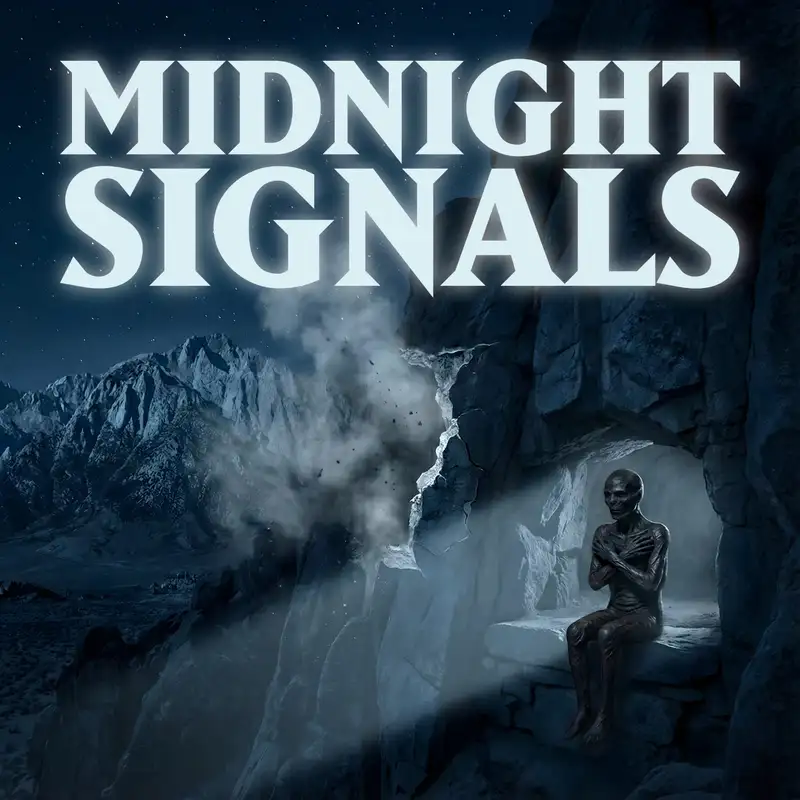
50 States of Folklore - Wyoming: They Found a Two-Foot-Tall Human
The fuse burned down and the mountain shook. For a moment, the violence of the dynamite was the only thing that mattered, tearing through the silence of the Wyoming wilderness. But as the smoke drifted and the dust began to settle on the San Pedro Mountains, it wasn't gold that glinted in the debris. The explosion had opened a door that was never meant to be found. It revealed a sealed cavern, a pocket of air trapped in the stone for centuries.
Speaker 1:Inside, sitting quietly in the dark as if waiting for the light to return, was a figure. It was too small to be a man, yet too human to be anything else. It was October 1932, and the country was in the grip of a depression that hollowed out men just as effectively as the wind hollowed out the canyons of Carbon County. Cecil Main and Frank Carr were not archaeologists. They were not looking for history or biology.
Speaker 1:They were prospectors, men driven by the singular, desperate hope of striking a rich vein of gold that would pull them out of the poverty that defined the decade. The San Pedro Mountains are not forgiving to rain. They are a jagged spine of ancient granite, rising up from the high plains, guarding their secrets with steep gulches and treacherous footing. The wind up here carries a bite, whistling through the scrub brush and the twisted pines, carrying the dust of a landscape that hasn't changed much since the glaciers retreated. The rock here is old and stubborn.
Speaker 1:Maine and Carr had been working a claim that showed promise, following the traces that usually lead to a payout. But the mountain had stopped them cold. A wall of rock stood in their path, a dead end that required more than just picks and shovels. They needed force. The labor of drilling shot holes into solid granite is rhythmic and brutal.
Speaker 1:It is the sound of steel on stone, ringing out across the empty landscape. They packed the holes with blasting powder, set the fuses, and retreated to safety. The explosion that followed didn't just crack the rock, it changed the trajectory of history in the American West. The blast rippled through the ground, a tremor that traveled up through the soles of their boots. It wasn't just a noise, it was a physical shove from the earth itself.
Speaker 1:The air filled with the sharp, stinging scent of sulfur and pulverized stone. In the immediate aftermath of a blast, the world goes strangely quiet, as if the landscape is holding its breath to see the damage. Maine and Carr moved back toward the face of the cliff, expecting to see a pile of rubble they would have to clear. They expected to see the fresh gray of fractured granite or, if luck was with them, the dull shine of ore. Instead, they found a void.
Speaker 1:The dynamite had done more than shatter the surface, it had breached a seal. The dust swirled around a dark opening, a mouth in the mountain that hadn't breathed in thousands of years. The sheer face of the rock had hidden a natural cavern, completely cut off from the outside world until that precise moment. It was a space that felt intentional, a pocket of stillness in a chaotic landscape. The air that drifted out was stale, smelling of dry earth and time.
Speaker 1:Most men would have looked at the hole with frustration, but there was something about the darkness of that opening that pulled them in. It wasn't a mineshaft or a natural fissure caused by the blast, it looked deliberate. The rubble lay scattered at the entrance, but beyond the jagged edges of the blown rock, the space opened up. The silence coming from the hole was heavy. It was the kind of silence that feels occupied.
Speaker 1:Main and Carr stood at the threshold of a discovery that defied their understanding of the world. They had come for precious metal, for something dead and cold. But the mountain had offered them something else entirely. They didn't turn back. They didn't wait for the dust to fully clear.
Speaker 1:One of them, likely driven by a mix of greed and curiosity, squeezed through the opening the dynamite had carved. The transition was instant. One moment, they were standing in the crisp, open air of a Wyoming Autumn, surrounded by the wreckage of their own making. The next, they were standing inside a tomb. The flashlight beam cut through the gloom, slicing across the stagnant air.
Speaker 1:The interior was small, a rough chamber maybe four feet high and four feet wide, extending back into the granite for about 15 feet. It was a pocket, a bubble in the geology of the mountain that felt entirely separate from the natural fissures of the area. The floor was flat, dusted with the debris of ages past. But the miners didn't look at the floor. Their eyes were drawn instantly to a small, flat ledge of rock that jutted out from the back wall like a natural shelf.
Speaker 1:There, sitting in the center of the ledge, was the occupant. In the dim, wavering light of the torch, the figure initially looked like a doll, or perhaps a crude carving left by some ancient artisan. It sat cross legged, its arms folded tightly across its chest in a posture of eternal patience. It sat upright, rigid, staring blindly into the darkness that had held it safe for centuries. It looked like it was waiting.
Speaker 1:Main and Carr moved closer, their boots crunching on the stone floor, disrupting the silence. As the light stabilized on the figure, the texture became undeniable. It wasn't the smooth coldness of stone. It wasn't the grain of wood. It was skin.
Speaker 1:The figure was tiny. Sitting in that lotus position, it was only about six or seven inches tall. If it were to stand, it would barely reach past a man's shin, standing perhaps fourteen inches in total height, but the proportions were wrong for a child. This was not an infant, this was a fully formed being. The skin was dark, a deep bronze color, turned leathery and hard by the dry mountain air and the hermetic seal of the cave.
Speaker 1:It was pulled tight against the bone, preserving every contour of the skeleton beneath, shrinking and hardening over time until it became a shell. The face was the most arresting part of the anatomy. It was a human face, but distorted, pushed into shapes that felt alien. The eyelids were heavy and drooping, giving the creature a look of deep, sorrowful exhaustion. The nose was flat, the nostrils flared, the lips were thin, drawn back slightly to expose the gum line.
Speaker 1:The forehead retreated sharply, sloping back from the heavy brow. The top of the skull was flattened, almost as if it had been pressed down by a heavy weight. Resting on top of this misshapen head was a strange, dark substance. It appeared gelatinous, dried out now into a resin like cap, but clearly applied with intent. It sat there like a crude crown or a medical poultice, a remnant of some unknown ritual performed before the stone door was sealed.
Speaker 1:The details were precise. The hands resting on the knees were perfect miniatures. The fingers were long and slender, and at the ends of them, tiny fingernails were still visible, perfectly preserved. These were not the hands of a carving. They were the hands of something that had once lived, grasped, and worked.
Speaker 1:The reality of what they were looking at began to settle in the cramped space. This wasn't a prop. It was a biological entity. There is a specific kind of fear that comes from finding something that defies categorization. It wasn't a skeleton, it was a mummy, preserved by the unique atmospheric conditions of the sealed cave.
Speaker 1:It felt heavy with presence. The eyes were closed, but the posture suggested alertness. It felt as though the explosion had not just revealed the figure, but disturbed it. The miners were intruders in a space that had been curated for silence. The figure sat there with a dignity that unnerved them.
Speaker 1:It was a guardian of its own tomb, a sentry that had stayed at its post while the world outside changed. Maine and Carr made the decision to remove it. They reached out and lifted the small body. It was light, weighing less than a pound, dried out to a husk, but it held its shape. It didn't crumble.
Speaker 1:The structure was solid, rigid as wood. As they pulled the figure from the ledge, the dynamic of the mountain changed. The tomb was empty. They carried the small bronze man back through the shattered opening, out of the stillness and into the bright, harsh light of the Wyoming afternoon. The wind hit the dried skin for the first time in untold generations.
Speaker 1:The strange air of the cavern dissipated, replaced by the smell of sagebrush and dust. They descended the slopes of the San Pedro Mountains, carrying a mystery that would confuse science and validate legends. The creature had left the stone. The arrival of the figure in the populated valleys of Wyoming brought with it a wave of unease that rippled through the local communities. In the early days following the discovery, the mummy sat as a curiosity, a grotesque object that defied the neat categories of the known world.
Speaker 1:It was displayed in drugstores and passed between hands, treated as a sideshow attraction or a hoax manufactured from dried leather and animal bones. Yet, those who looked closely found their skepticism faltering. The texture of the skin, the intricate details of the fingernails, and the undeniable presence of the face suggested a biological reality that a mere fabrication could not achieve. It demanded a deeper look, one that could strip away the leathery exterior and reveal the truth hidden beneath. The turning point came when the figure was subjected to the cold, impartial gaze of medical imaging.
Speaker 1:The decision to place the mummy under an x-ray machine was an attempt to settle the debate once and for all, to prove it was a composite doll or a tragic, malformed infant. But when the plates were developed and the internal structure was illuminated against the backlight, the mystery did not dissolve. It deepened. The film revealed a perfect, complete skeletal system. This was not carving of wood or a bundle of wires, it was a complex network of bone, articulating perfectly at every joint.
Speaker 1:The anatomy visible on the x-ray plates was baffling. The first anomaly to draw the eye was the rib cage. In a human infant, the rib cage is pliable and relatively narrow. The creature from the San Pedro Mountains possessed a rib cage that was barrel shaped, rigidly constructed, and disproportionately large for its frame. It suggested a being built for deep breaths, perhaps evolved to process oxygen in high altitude environments or the thin air of deep subterranean caverns.
Speaker 1:The structure was robust, indicating a physical strength that belied the creature's diminutive stature. However, it was the skull that shattered the theory of this being a human child. The jaw was set with a full complement of teeth. They were not the milk teeth of an infant, nor were they the emerging buds of a toddler. They were the permanent, rooted teeth of a fully mature adult.
Speaker 1:But they were different. The canines were excessively pointed, sharp and long, sitting in the jaw with a predatory readiness. The layout of the mouth was not that of a modern human. It was the mouth of something that tore its food. The wear patterns on the enamel suggested decades of use.
Speaker 1:Based on the dental development and the fusion of the cranial sutures, anthropologists later estimated the being was approximately 65 years old at the time of death. The bones told a biography of violence. The x rays highlighted a healed fracture in the left collarbone. The break was clean and the bone had knit back together, leaving a thick callus that proved the creature had survived the injury and lived for years afterward. This implied a level of care or an incredible resilience.
Speaker 1:Someone, or something, had tended to this being, or it had possessed a constitution strong enough to heal without modern aid. The spine, however, showed signs of chronic stress. The vertebrae were compressed and fused in places, a condition often seen in those who carry heavy loads or live a life of intense physical exertion. This was a body worn down by gravity and labor. The cause of death was written just as clearly in the skeletal record.
Speaker 1:The top of the skull, beneath that strange gelatinous cap, had been crushed. The parietal bones were depressed, signaling a massive blunt force trauma that would have been instantly fatal. The spine was severed at the neck, likely from the same impact. The position of the body, arms folded, legs crossed, suggested that this damage occurred before it was placed in the cave, or perhaps was the reason for its interment. Most disturbing was the shadow resting in the abdominal cavity.
Speaker 1:The x rays picked up the distinct density of food matter still preserved within the stomach. It wasn't grain or plant matter. The analysis pointed to raw meat and bone fragments. The creature had eaten shortly before it died, and its diet was carnivorous. It chewed on the bones of small animals, swallowing them whole.
Speaker 1:The image of the San Pedro mummy shifted instantly from a tragic, deformed outcast to something far more capable. This was not a helpless infant abandoned on a ledge. This was a hunter, an elder, and a warrior who had lived a long, hard life before meeting a violent end. The dynamite had not just found a body, it had found a species. The medical evidence provided a physical map of the creature's life, but it was the local folklore that provided the name.
Speaker 1:For the Shoshone people indigenous to this rugged territory, the discovery of the tiny man was not a revelation of something new, but a terrifying confirmation of something very old. The attributes revealed by the x rays, the sharp teeth, the warrior's injuries and the violent death aligned with chilling accuracy to the legends of the Numerigar. To the scientists, the mummy was a puzzle. To the elders of the Wind River Range, he was a known enemy. In the Shoshone tongue, the word Numerigar translates roughly to people eaters.
Speaker 1:These were not the benevolent sprites or mischievous fairies found in European folklore. They were described as a distinct race of diminutive beings, standing roughly two to three feet tall, who inhabited the windswept slopes and deep canyons of the San Pedro and Wind River Mountains. The stories passed down through generations did not paint them as magical, but as dangerously physical. They were a rival civilization, fierce competitors for the resources of the land, and they were feared. The Shoshone viewed them not as spirits, but as a hostile tribe that occupied the same physical space, a constant threat lurking in the periphery of their vision.
Speaker 1:The legends spoke of the Numeragar as masters of the ambush. They used their small stature to their advantage, hiding in the crevices of the rock and the thick scrub brush where a full sized man could not follow. They were said to be aggressive warriors who armed themselves with tiny bows and arrows. According to the lore, they dipped the tips of these arrows in a potent poison, making even a small scratch fatal. This made them a formidable threat to the Shoshone, who learned to avoid certain valleys and cave systems known to be the territory of the Little People.
Speaker 1:The mountains were not just empty wilderness, they were a fortress for a hostile power that defended its borders with lethal precision. However, the most striking detail of the legend, the one that made the blood of those who saw the mummy run cold, concerned how the Numeragar handled their own dead and dying. The oral history was specific. It was said that when a member of the Numeragar society became too old to be useful, or too infirm to keep up with the tribe's movements, they were not nursed. They were executed.
Speaker 1:The custom dictated that the infirm were killed by a single, crushing blow to the head with a stone club. It was a brutal form of euthanasia, a way to maintain the strength of the group by culling the weak. The San Pedro mummy bore the exact signature of this ritual. The x rays had proven that the being was an elder, roughly 65 years old, with a spine compressed by a lifetime of hard labor. He had lived a violent life, survived a broken collarbone, and continued to fight until his body began to fail.
Speaker 1:And his life had ended exactly as the stories predicted, with a massive, crushing impact to the top of the skull. The gelatinous substance found on the head may well have been part of this ceremonial execution, a final rite performed before the body was sealed away in the rock. This convergence of forensic science and ancient myth transformed the narrative. The mummy was no longer just a biological oddity. He was a piece of history that validated the oral traditions of the Shoshone.
Speaker 1:The legends were not warnings about spirits, they were warnings about a tangible threat, A carnivorous species that lived alongside the indigenous tribes, fighting wars and protecting their territory. The barrel shaped chest of the mummy, suited for high altitude survival, suggested that the Namaragar were perfectly adapted to the environment, perhaps even more so than the humans who feared them. The mountains suddenly felt much more crowded. The discovery implied that the Nimerigar were not solitary monsters, but a society. If this mummy was a warrior and an elder, he had peers, he had a family, he had a tribe that buried him.
Speaker 1:The idea that a parallel civilization had existed in the cliffs, watching the human world expand while they retreated deeper into the stone, added a psychological weight to the wilderness. The explosion in 1932 hadn't just found a body, it had proven that the little people were real, and that the stories of their violence were based on hard, bloody facts. The Mummy was not a unique anomaly, but a single soldier from a lost army. If the excavation in the San Pedro Mountains had been a singular, isolated event, it might have been possible for the scientific community to dismiss it as a freakish anomaly. A single deformed birth, abandoned in a cave, is a tragedy, not a history altering revelation.
Speaker 1:But the mountains of Wyoming are vast, and they are consistent in the secrets they keep. In the years following the initial blast, the silence of the high country was broken by other reports that mirrored the first in disturbing ways. The most significant of these occurred roughly three decades later, in the same sprawling granite range. This discovery, often referred to as the Little Man, provided the second coordinate needed to draw a line through history. This second figure was found deep within a limestone fissure, wrapped in what appeared to be primitive, decaying textiles.
Speaker 1:The physical description of this specimen aligned with the San Pedro mummy with a precision that ruled out coincidence. It possessed the same heavy, aggressive brow, the same sharp, predatory teeth, and same barrel shaped rib cage designed for an environment hostile to normal human life. The existence of a second specimen transformed the narrative from a story about a unique biological mistake into a dossier on a distinct population. These were not random mutations they were members of a uniform biological group that shared specific, inheritable traits. The locations of the discoveries, always deep within the rock, always sealed in small, inaccessible caverns, suggested a deliberate cultural pattern of burial.
Speaker 1:The mountains were not just a habitat, they were a necropolis for a race that the modern world had decided did not exist. Despite the mounting physical evidence and the corroboration of indigenous lore, the San Pedro mummy did not find a sanctuary in a research institution. Its journey was not one of scientific reverence, but of commercial exploitation. For years, the tiny figure sat in the window of a local drugstore in Meeteetse, Wyoming, a grotesque curiosity sandwiched between headache powders and postcards. It was gawked at by tourists and poked at by skeptics, treated as a local mascot rather than a biological revelation.
Speaker 1:The indignity of its display served to cheapen its significance, allowing serious academics to dismiss it as a roadside gaffe without ever examining the bones. Eventually, the allure of profit outweighed the value of local history, and the mummy entered the volatile private market. In the nineteen fifties, the artifact was acquired by Ivan T. Goodman, a businessman from Casper, Wyoming. Goodman brought the mummy to New York, seeking validation from the scientific establishment, believing he held the proof of a lost branch of the human family tree.
Speaker 1:When Goodman passed away, the ownership transferred to Leonard Walder, a private collector who had amassed a significant array of oddities. Walder, unlike the roadside gawkers, understood the potential value of what he held. He reportedly had the specimen re examined, confirming the organic nature of the tissues and the reality of the bone structure. But possession by a private individual is a precarious thing for history. Then, the trail simply stopped.
Speaker 1:Following Walder's death, the San Pedro mummy vanished. It did not pass to a university, it was not donated to a museum, it simply ceased to exist in the public record. Rumors swirled that the family, unaware of its significance, had discarded it with the rest of Walder's estate. Others whispered that it had been sold into a private collection so exclusive that the item would never see the light of day again. There is a darker theory that persists among those who chase hidden history, that the artifact was deliberately removed from circulation.
Speaker 1:When physical evidence challenges the established timeline of human evolution, it has a habit of disappearing. A species of intelligent, tool using, carnivorous hominids living in North America alongside modern humans disrupts the accepted narrative. It complicates the history of the continent. The disappearance of the mummy conveniently reset the status quo. Without the body, the x rays could be dismissed as fakes, the reports as exaggeration, and the minors as liars.
Speaker 1:The loss of the artifact turned a scientific fact back into a campfire story. Today, all that remains are the photographs, the medical reports, and the lingering silence where the body used to be. It forces us to ask if the evidence was lost by accident, or if it was buried for a second time to keep the door to that hidden world firmly shut. The vanishing of the physical evidence forces us to look away from the museums and back to the source, the mountains themselves. To understand the San Pedro Mummy, one must consider the possibility that the surface of the earth is merely a ceiling for another world entirely.
Speaker 1:The geology of Wyoming is not a solid block of granite. It is a fractured, honeycombed landscape, riddled with fissures, lava tubes, and limestone caverns that extend miles beyond the reach of any map. We assume that because we have surveyed the peaks, we know the territory. But the discovery of a species so perfectly adapted to the dark suggests that an extensive underground ecosystem may have existed, and perhaps still exists, beneath our feet. Evolution is a ruthless architect.
Speaker 1:It does not design features without cause. The physical anomalies of the mummy, the diminutive stature, the heavy eyelids, and the immense, barrel shaped chest are not random deformities. They are solutions to a specific set of problems. In the deep, subterranean environment, resources are scarce. A large body is a liability, requiring too much caloric intake to sustain.
Speaker 1:A smaller frame is efficient. It requires less food and can navigate the tight, twisting capillaries of the rock. The Numerigar were not stunted humans. They were optimized for a life where the ceiling is always low. The barrel chest, which baffled the initial medical examiners, makes perfect sense in this context.
Speaker 1:Deep inside the crust, the air grows thin and stagnant. Oxygen levels drop. A standard human lung capacity would suffocate in the deep fissures of the San Pedro Range. But a rib cage expanded to hold massive lungs would allow a creature to pull every available molecule of oxygen from the bad air of the caves. This was a biological machine built to thrive in conditions that would kill a surface dweller.
Speaker 1:It suggests that while humanity was conquering the plains, a parallel lineage was conquering the dark. This leads to the retreat theory. The legends of the Shoshone speak of a time when the little people fought openly on the surface. But as the indigenous tribes grew in number and strength, and later as miners like Maine and Carr arrived with dynamite and machinery, the surface became hostile territory. It is entirely possible that the Nimaragar did not go extinct in the traditional sense.
Speaker 1:Instead, they withdrew. They retreated down into the veins of the earth, pulling the stone shut behind them. The mummy found in 1932 might not have been a remnant of a dead civilization, but a rearguard, a sentry left behind to seal the door as the rest of his people descended beyond the reach of the sun. The concept of the sealed door changes how we look at the wilderness. Maine and Carr found one opening because they happened to blast a specific section of rock at a specific angle.
Speaker 1:But the San Pedro Mountains are vast. How many other sheer cliff faces are actually facades hiding hollow chambers? How many other elders sit in the dark, arms folded, waiting for a blast that never comes? The statistical likelihood that these prospectors found the only tomb is infinitesimal. The mountain is likely a hive of such chambers, a silent city of the dead, or the sleeping, that we simply lack the eyes to see.
Speaker 1:There is a profound psychological weight to this theory. We like to believe we are the sole inheritors of the Earth's intelligence. We accept that we share the planet with animals, but the idea of another tool using, language speaking, organized society is deeply unsettling. It triggers an instinctual fear, the feeling of being watched by eyes that understand what they are seeing. The Numerigar represent a branch of the family tree that didn't wither, but grew in a direction we cannot follow.
Speaker 1:They are the shadow to our light, the masters of the space we fear most. The most haunting implication of the hidden world theory is that the story isn't over. If the adaptations were successful, and the cave systems are as deep as geologists believe, there is no reason to assume the Naimaragar are gone. They may simply be deeper than our drills can reach. We scratch the surface with our minds and our roads, oblivious to the life that might be shifting in the dark a mile beneath our tires.
Speaker 1:The mountains are not empty, they are just quiet. And as any miner knows, the silence of the underground is not the same thing as emptiness. The granite walls of the San Pedro Range stand as a barrier between two realities. On one side is the modern world of noise, industry, and sunlight. On the other is a silent, suffocating dark where the rules of biology are rewritten.
Speaker 1:The mummy was a messenger from that other side, a brief glimpse through a crack in the wall before the evidence was snatched away. We are left staring at the stone, wondering what lies behind the next wall of granite, and whether the things that live there are still listening to our footsteps on the roof of their world. The San Pedro Mountains have returned to their silence. The dust from sea sill mains dynamite settled decades ago, and the wind has long since scrubbed away the boot prints leading to that jagged hole in the rock. But the mountain is not the same.
Speaker 1:It is no longer just a geological formation of granite and scrub brush. It stands now as a vault, a keeper of secrets that humanity was perhaps never meant to hold. The disappearance of the mummy demonstrates the terrifying fragility of truth. We rely on physical objects to anchor our reality, to prove that the impossible actually happened. When those objects are removed, the truth becomes fluid.
Speaker 1:It slips back into the realm of folklore, easily dismissed by those who find safety in the known world. Yet the story refuses to die. It endures because the x rays remain. Those grainy, black and white images act as a permanent scar on the historical record. They are the shadow that proves the object casts a light.
Speaker 1:You can lose a body, you can bury a report, but you cannot unsee the anatomy of a predator hidden inside the frame of a small man. The medical plates serve as a tether, binding the modern skeptic to the ancient reality of the Nimerigar. They remind us that for one brief moment, the veil was lifted. The explosion in 1932 was likely a singular accident, a rare instance where the chaotic violence of human industry inadvertently synchronized with the hidden architecture of the earth. It was a glitch that allowed two incompatible worlds to touch.
Speaker 1:There is a warning implicit in this discovery. We dig, we blast, and we excavate with the arrogance of a species that believes it owns the dirt it stands on. But the mummy on the ledge suggests that we are merely tenants living above a basement we have never visited. The fact that the figure was sealed in, deliberately walled off from the outside, implies that the separation was intentional. The Nimaragar, or whoever buried that warrior, wanted the door closed.
Speaker 1:They understood that their survival depended on remaining unseen, on keeping the seal unbroken. The mountains are not passive observers. They are active participants in the concealment of this history. Every landslide, every collapsed tunnel, and every lost artifact serves to reinforce the barrier between us and them. The Naimarigar are safe, because we cannot believe in them without the body.
Speaker 1:This is their ultimate defense mechanism. In a world ruled by science, the unproven is nonexistent. By vanishing, they survived. Maine and Carr were lucky. They peered into the abyss and carried a piece of it home, but they faced no retaliation.
Speaker 1:They robbed a grave and lived to tell the tale, but one has to wonder if the luck holds for those who keep digging. The mountain has swallowed the evidence, pulling the curiosity back into the dark. The ledge where the little man sat for centuries is empty now, a vacant throne in a silent room, but the emptiness is deceptive. The logic of the hidden world suggests that the ledge was just an outpost. The true civilization lies deeper, beyond the reach of our dynamite, protected by miles of crushing stone.
Speaker 1:The seal has been repaired, not by rock, but by the absence of proof. The Numeragar have returned to the status of ghosts, which is exactly where a hunter operates best. The cavern in Carbon County remains, a hollow space in the granite that once held a king of the underground. While the physical body has vanished into the private collections of the elite or the dust of history, the x rays stand as the final testament to a reality we barely understand. The legends of the American West are not always fables.
Speaker 1:Sometimes they are history waiting for the right fuse to burn down. The truth is out there, buried under the weight of the impossible. Keep looking for the cracks in the wall. This has been Midnight Signals. I'm Russ Chamberlain, guiding you through the shadows where history meets mystery.
Speaker 1:Until next time, stay vigilant, seek the hidden, and remember, in every silence, there is a signal, and in every signal, a story waiting to be told.