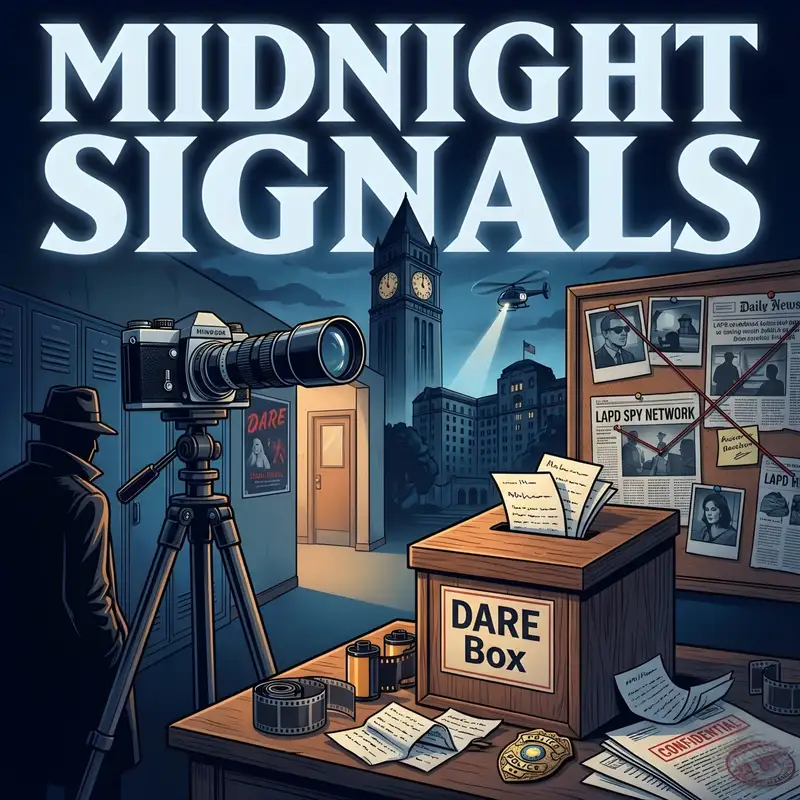
D.A.R.E. | The REAL Reason They Were in Your School
06/04/1968. A 15 year old boy walks into the Ambassador Hotel in Los Angeles with a camera around his neck. He's on assignment for his high school newspaper. Senator Robert F. Kennedy is giving a speech, and the kid's job is to capture it on film.
Speaker 1:After the speech ends, the boy follows Kennedy through the hotel kitchen, snapping photos, then gunshots. The senator collapses. In the chaos, the teenager keeps shooting, not bullets, but frames. He documents everything, the crowd, the blood, the struggle as a former NFL player named Rosie Greer wrestles the gunman to the ground. The LAPD arrives.
Speaker 1:They detain the boy. All three rolls of film are confiscated. Two months later, the department reportedly burns 2,410 photographs from the investigation. Ceiling panels with bullet holes, destroyed. X rays of those panels, gone.
Speaker 1:Spectrographic analyses of the bullets, erased. A young officer named Darryl Gates was working in the intelligence division when this happened. He watched as evidence vanished. He learned something important that night. When you control the files, you control the truth.
Speaker 1:This isn't about conspiracy theories. It's about what happens when police decide the rules don't apply to them. Gates would spend the next fifteen years building something unprecedented, a domestic spy network that critics say operated outside the law, beyond oversight, answerable to no one. And when that network was finally exposed and ordered destroyed, he found a way to bring it back. He just needed the right cover story.
Speaker 1:Gates climbed fast through the LAPD ranks. After overseeing the intelligence division, he made assistant chief. Journalists who covered him used words like narcissist, egomaniac, paranoid. His ego was beyond belief, one reporter said. But ego alone doesn't build empires.
Speaker 1:Gates had something more dangerous, absolute loyalty from the officers beneath him. The intelligence division split into two branches. One handled organized crime, the other, called the Public Disorder Intelligence Division, PDI for short, was supposed to monitor riots and civil unrest. Instead, it became something else entirely. According to court records, PDI abandoned its mission almost immediately.
Speaker 1:Officers started building dossiers on journalists, labor unions, civil rights groups, anti war activists. They even spied on the mayor. This wasn't federal surveillance. This was a municipal police department accused of operating like the CIA. Gates deployed hundreds of undercover officers around the world.
Speaker 1:Not the FBI, not a federal agency. The Los Angeles Police Department, a local force with global reach. Then PDI got caught. Reports surfaced that they'd been running covert operations inside schools, not investigating crimes, but building political files on students and teachers. The California Supreme Court stepped in.
Speaker 1:You can't send undercover cops into schools without probable cause, they ruled. The L. A. Board of Police Commissioners ordered the destruction of 1,900,000 dossiers. But Watergate had just happened.
Speaker 1:America was waking up to government surveillance. The FBI had run Cointell Pro. The CIA had Operation Chaos. Cities and states started passing laws. If you're spying on someone and no crime has been committed, you must delete the file.
Speaker 1:A congressman from New York wanted answers about the Kennedy assassination. He started asking questions about LAPD's investigation. A memo made its way to Gates, responding point by point. One line stood out. A key photograph taken during the investigation was kept secret by Los Angeles police who feared it might contradict official statements.
Speaker 1:The memo noted, The existence of this photograph is believed to be unknown by anyone outside this department. The Senate Intelligence Committee summoned the LAPD Chief to Washington. They wanted names, everyone who was spying for the department. The Chief's response was a declaration of war. It will be a cold day in hell when I provide you with the information you've requested.
Speaker 1:Back in Los Angeles, one of the PDI spies received quiet orders. Don't destroy the records. Hide them. Three years later, Daryl Gates became chief. He inherited total control of a militarized force with an elite spy network that had just learned how to operate in the shadows.
Speaker 1:But the new surveillance laws created a problem. If no crime was committed, you couldn't keep the files. Gates needed a loophole. He found it in the one thing these laws couldn't regulate: private businesses. Representative Larry McDonald, chair of a right wing advocacy group, teamed up with his allies to create the Western Goals Foundation.
Speaker 1:On paper, it was a think tank. In reality, investigators argued it functioned as a domestic intelligence agency operating as a private company. Allegations surfaced that the LAPD funneled its hidden PDI records to Western Goals. Over two years, they reportedly infiltrated 200 groups: city council meetings, journalists, academics, the ACLU, celebrities, LGBTQ activists, labor unions, the political left. Undercover agents sat in the city council chamber, reporting on what councilmen said, tracking their votes, building files.
Speaker 1:A journalist named Dave Lindorf became a target. He described helicopters following him home at night, shining lights on his building. 144 people sued Gates, backed by the ACLU. Things got hot, but Gates struck back, winning a separate case. The ruling said undercover cops could operate in schools, as long as they were targeting drug dealers.
Speaker 1:The ACLU planned to appeal. They just had to prove one thing: that Gates would abuse that power. So they focused on the PDI case. Then the city attorney representing Gates opened an unlocked file cabinet. What he found made him run to the press.
Speaker 1:He famously called PDI a clandestine band of zealots who abuse every single moral and ethical precept. The judge prepared to order the release of all PDI files. But before that could happen, the news broke. The ACLU had evidence that Gates had been funneling intelligence to Western goals. It was fully public now.
Speaker 1:The ACLU closed in. PDI officers started what they called the Purge, destroying tens of thousands of documents. Witnesses described them burning up two commercial shredders. Gates ran to the school board with a pitch: drug education taught by police officers. Not just one class.
Speaker 1:Keep them there, embedded in the schools. The school district said no. A program cannot be developed overnight. Gates approached researchers at USC who'd developed an anti drug curriculum called Project SMART. He wanted to use his cops to teach it.
Speaker 1:The researchers refused. They had serious objections to police involvement. But they agreed to share their findings. They'd tested two approaches. One worked, one didn't.
Speaker 1:The approach that didn't work, they called it the effective education component, actually made kids more likely to try drugs. They'd dropped it from their program. Gates kept it in. The surveillance network he'd built was about to be destroyed for the second time. The courts were closing in.
Speaker 1:The ACLU had momentum. He needed a new way in. He went back to the school board. Drug education programs taught by uniformed police officers, not guest speakers. Full time assignments, cops embedded in elementary schools across the city.
Speaker 1:The school board was skeptical, but Gates had already started. In 1983, as the ACLU lawsuit reached its climax, Gates sent 10 officers into 50 elementary schools. It was a trial run. The following year, the city settled the lawsuit. Gates officially launched D.
Speaker 1:R. E, drug abuse resistance education. Year one went smoothly. Year two brought an incident. A cop accidentally discharged a revolver in a classroom.
Speaker 1:Year three revealed a pattern. Six kids turned in their parents for drug use in a three month period. D. R. E.
Speaker 1:Had to create a policy. Officers received instructions telling them, You're not here to gather intelligence. You're here as a teacher. The training documents emphasized certain phrases repeatedly: gain their trust, build rapport. But the policy created a conflict.
Speaker 1:If a child confided something to an officer, the policy said to get another officer to handle it. The reasoning was explicit. You can't lose the kid's trust. The curriculum introduced something called the D. R.
Speaker 1:Box. It was a decorated container that sat in the classroom. Students could drop notes inside, questions, concerns, confessions. Officers instructed students on how to use it. If you want it private, make note of it.
Speaker 1:This is between you and I. Critics called it a literal confession box, a mechanism that effectively bypassed the parent child bond. As D. R. E.
Speaker 1:Expanded, more children turned their parents in. Parents compared the program to informant systems in authoritarian regimes. A former officer who worked under Gates called using kids to inform on parents bottom of the barrel. The psychological damage was documented. Kids discovered years later that they were responsible for their parents' arrest.
Speaker 1:They lived with that guilt. Wikipedia's description of D. E. Notes that the program became known for using children as informants. When asked if using kids as informants aligned with what he knew about Daryl Gates, the former officer said, Oh yeah, I have no doubt that it occurred to him that this was a possibility.
Speaker 1:To many observers, the confession box wasn't a bug in the system. It looked like a feature. But the box was just the surface. Behind D. R.
Speaker 1:Was a private corporation with extraordinary reach. The nonprofit structure allowed Gates to do something the L. A. P. D.
Speaker 1:Couldn't, take money from businesses. And once the money started flowing, so did the power. Dare America was born. Today, this structure is normal. They're called police foundations.
Speaker 1:According to critics, they can operate as dark money slush funds with low transparency. Legally, these foundations can't imply that donors will influence official police actions or receive anything in return, but oversight is minimal. Dare America threw fundraiser galas, inviting wealthy donors. The dinner chair of one early gala was a luxury goods and jewelry mogul. He landed a seat on the board of directors.
Speaker 1:A banker attended. He made the board. A developer showed up. Board seat. An attorney came to the event.
Speaker 1:Her son suddenly joined the board. That single gala netted D. A. R. E.
Speaker 1:More than 7 and $60,000 The timing was perfect for Gates. President Reagan accelerated the war on drugs. The nation united against this scourge as never before. The First Lady attended D. A.
Speaker 1:R. E. Fundraisers. Walt Disney's daughter gave an extraordinarily generous donation and joined the board. The federal government prepared to pass a bill funding anti drug programs.
Speaker 1:D. R. E. Sent a lobbyist to Washington. That bill was amended to specifically allocate money for programs taught by uniformed law enforcement officials.
Speaker 1:D. A. R. Used government funding to create regional training centers. They developed a decentralized business model: board of directors at the top, then executives, employees, training centers, and finally the officers themselves.
Speaker 1:But if they hired cops directly, those cops would no longer be police officers. So D. R. Helped local police departments set up their own private nonprofits. They dedicated much of the officer training to teaching cops how to raise money.
Speaker 1:Then they coached those officers to expand their programs and recruit more officers. A triangle structure. It bore a striking resemblance to the business model of Herbalife, whose founder and executive vice president both joined DARE's board of directors. They donated $36,000 specifically designated for rent. With this corporate cash fueling the engine, the program became a juggernaut, expanding into 75% of American school districts.
Speaker 1:It was a massive financial success. But while the money piled up, the actual curriculum went largely unscrutinized. For years, the program ran on anecdotes and good vibes. Then, the data finally caught up. A three year study commissioned by the Department of Justice found that D.
Speaker 1:R. E. Didn't work. The DOJ had approved the independent agency's approach, receiving feedback throughout the process. Everything looked good, until the findings came in.
Speaker 1:The Department of Justice refused to publish the results. The researchers went to the American Journal of Public Health, one of the most respected academic journals in the field. The study received exceptionally good peer reviews, the journal prepared to publish. Then Dare called. According to the journal, Dare tried to intimidate them, attempting to prevent publication.
Speaker 1:A major television network worked on a story about the program's failure. The producer said Dare worked very hard to get our story suppressed. When a USA Today reporter questioned the program's effectiveness, he received coordinated letters from classrooms across the country. All addressed the same way: Dear Dare Basher. For years, Dare attacked anyone who criticized the program, but their war wasn't just against reporters.
Speaker 1:It was against anyone who tampered with the formula, even if they were trying to fix it. The organization was so protective of its brand that when foreign schools tried to make the program actually effective, D. R. Didn't thank them. It threatened them.
Speaker 1:In The United Kingdom, schools taught the D. A. R. Curriculum, but modified it over time. They still used cops, but added professionals and educators.
Speaker 1:D. A. R. E. Sent them a cease and desist for trademark violation.
Speaker 1:After The UK made those changes, studies found overall positive results. D. R. Finally admitted the truth on their website. Scientists have repeatedly shown that the program did not work.
Speaker 1:They launched a new program. Attorney General Jeff Sessions attended the gathering. Over the past three years, Dare has had record breaking expansion, training thousands of new cops. The confession boxes are back in classrooms across America. If it walks like surveillance and talks like control, it probably isn't about drugs.
Speaker 1:Dare gave Gates exactly what he wanted. Cops in schools, access to families, and a network the law couldn't regulate. This has been Midnight Signals. I'm Russ Chamberlain guiding you through the shadows where history meets mystery. Until next time, stay vigilant, seek the hidden, and remember in every silence there is a signal, and in every signal, a story waiting to be told.
Speaker 1:Visit midnightsignals.net to continue the conversation, explore more episodes, say hello.