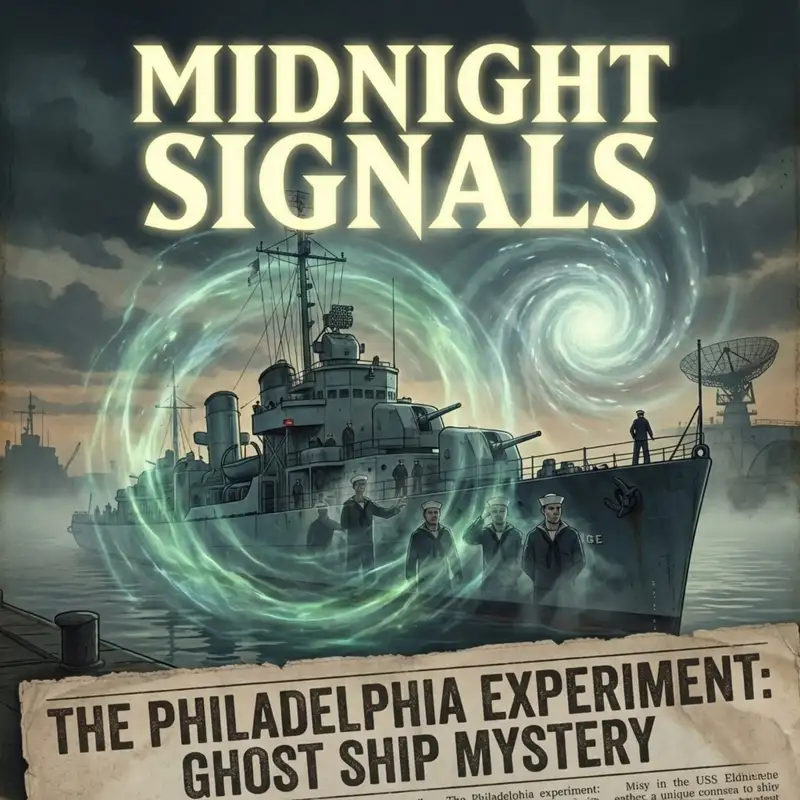
The Philadelphia Experiment: USS Eldridge, Green Fog, and the Road to Montauk
On 10/28/1943, the Philadelphia Naval Shipyard became the stage for an event that would haunt the edges of military history. The USS Eldridge sat in the harbor, a destroyer escort that looked ordinary to the naked eye. But inside its hull, the Navy had installed technology designed to do the impossible. The goal was to make the ship invisible to enemy radar. However, the result was far more terrifying than a simple tactical advantage.
Speaker 1:When the experiment began, the ship didn't just vanish from the screens, it reportedly tore loose from the physical world. The crew on board faced a destiny worse than death, trapped in a nightmare where the laws of nature no longer applied. The year 1943 was defined by desperation. The Second World War was raging and the Atlantic Ocean had become a slaughterhouse. German U Boats hunted in wolf packs, sinking Allied supply ships faster than they could be launched.
Speaker 1:The United States Navy needed a technological breakthrough to stem the bleeding. They needed a way to move ships through the water without being detected by the enemy. This urgent need gave birth to Project Rainbow. The project relied on the application of the Unified Field Theory, a complex physical concept that proposed a connection between electromagnetic and gravitational fields. The theory suggested that with enough energy, one could bend light and radar waves around an object, effectively rendering it invisible.
Speaker 1:The USS Eldridge was chosen as the test bed for this radical science. Workers fitted the ship with massive generators and miles of electromagnetic coils wrapped around the hull. The equipment was heavy, loud, and dangerous. When the technicians ran initial calibration tests, the ship didn't just sit quietly in the water. Witnesses claimed the vessel emitted a low frequency that caused nausea and disorientation among the crew.
Speaker 1:The air around the ship became charged with static electricity, causing blue sparks to jump from metal railings. During these early lower power tests, a strange phenomenon appeared. A greenish haze, described by survivors as a green fog, began to envelop the ship. It wasn't smoke, and it didn't drift with the wind. It clung to the hull, swirling with a life of its own.
Speaker 1:The sailors on board were terrified. They didn't understand the physics of what was happening, but they could feel the wrongness of it in their bones. The officers dismissed their fears, driven by the pressure to deliver a weapon that could end the war at sea. The official Navy records state that the Eldridge was on a shakedown cruise in The Bahamas during this time and that the experiment is a myth. They claim the story is a misunderstanding of degaussing techniques used to make ships magnetic neutral against mines.
Speaker 1:But the persistent rumors tell a different story. They describe a day when the calibrations were finished and the main test was authorized. The generators were pushed to their limits. The grew to a deafening roar. The green fog thickened, swallowing the ship entirely until the steel of the Eldridge was no longer visible from the dock.
Speaker 1:The scientists believed they were about to achieve tactical invisibility. In reality, they were turning the key on a door that led to somewhere else entirely. The switch was thrown, and the familiar world dissolved. The generators roared to life, their mechanical scream drowning out the shouting of the officers on the deck. The air pressure dropped instantly, causing ears to pop and the water around the hall to hiss as if boiling.
Speaker 1:The haze suddenly thickened into an opaque swirling barrier. It didn't behave like weather, it pulsed with an electrical rhythm, wrapping the USS Eldridge in a cocoon of energized particles. From the dock, observers watched in disbelief as the outline of the destroyer escort began to waver. It wasn't just fading from view, it was being erased. First the mast, then the gun turrets, and finally the hull itself dissolved into the green oblivion.
Speaker 1:Within seconds, the water where the Eldridge had been anchored was empty, save for a depression in the surface where the displacement of the ship should have been. The vessel hadn't just become invisible to radar, it had been ripped entirely from the Philadelphia Harbor. Hundreds of miles away, in the naval yards of Norfolk, Virginia, the impossible happened. Witnesses reported seeing the USS Eldridge materialize out of thin air. It didn't arrive effectively or safely.
Speaker 1:It flickered into existence, a ghost ship shrouded in residual static, visible for several minutes to the stunned personnel on the Virginia coast. The crew was reportedly visible on the deck, panic stricken and disoriented. Then, just as violently as it had appeared, the ship vanished from Norfolk, snapped back by the elasticity of the space time tether the experiment had created. The energy field collapsed, and the destroyer slammed back into existence in Philadelphia. The green fog dissipated, revealing the ship once more sitting in the water.
Speaker 1:But the silence that followed was heavy, broken only by the groans of the hull settling and the terrifying guttural screams of the men on board. When the support teams boarded the Eldridge, they walked into a scene of carnage that defied biology and physics. The ship was intact, but the crew was not. The electromagnetic fields had not just bent light, they had scrambled the molecular structure of everything inside the field. The most gruesome discovery was found on the lower decks.
Speaker 1:Sailors had been fused into the ship itself. During the phase shift, their bodies had occupied the same space as the steel bulkheads. When the ship rematerialized, flesh and metal solidified together. Men were found with their limbs buried deep within the solid steel walls, their bodies contorted in agony, their blood circulation cut off by the very ship they served on. One man was reportedly found with his hand and forearm completely merged with the metal of a hatch, the skin changing seamlessly into painted steel.
Speaker 1:They were alive, but they were trapped in a horrific union of man and machine. Those who escaped the physical fusion suffered a fate perhaps even more disturbing. The survivors were stumbling around the deck, their minds shattered by an experience the human brain was never meant to process. Some were on fire, but they weren't burning in the traditional sense, they were radiating a strange, cold energy that slowly consumed them. Others were fading in and out of visibility, flickering like a bad transmission.
Speaker 1:These men had become unstuck in time, walking through solid walls not by choice, but because their physical density was no longer constant. They were slipping away, lost to a dimension between seconds. The officers on the dock stared in horror at the result of their ambition. They had sought tactical invisibility, a way to hide from the enemy. Instead, they had stumbled upon a method to shred the fabric of reality.
Speaker 1:The deck was a slaughterhouse of physics, littered with the insane and the impossible. The medical teams had no protocol for men fused to steel or sailors who were half ghost. The experiment was immediately halted, the data classified, and the surviving crew quarantined and brainwashed. The Navy declared the experiment a failure due to the catastrophic human cost, but in the dark halls of military intelligence, it was viewed differently. The technology worked.
Speaker 1:The ship had moved through space and time. The door had been opened, and though they closed it that day in 1943, the knowledge of what lay on the other side would eventually lead them to even darker places. The story of the USS Eldridge should have ended in the classified incinerators of the Department of the Navy. The ship was eventually sold for scrap, the logs were sanitized, and the survivors were silenced. But a secret of this magnitude has a way of bleeding through the cracks of history.
Speaker 1:It began as a whisper in the nineteen fifties, carried by the frantic, disjointed letters of a man named Carlos Allende. He wrote to Morris K. Jessup, an astronomer and author, detailing the horrors he had witnessed from a nearby merchant ship, the SS Andrew Furiseth. Allende's letters were bizarre, written in multiple colors of ink with erratic capitalization, but they contained specific, terrifying details about the magnetic fields and the men who got stuck in them. These letters became the first thread in a tapestry that would eventually lead to a much darker conspiracy decades later.
Speaker 1:While Allende provided the observation, a man named Al Beelich provided the experience. Years after the war, Beelich emerged with a story that sounded like the ravings of a madman, yet he possessed an uncanny knowledge of classified naval technology. He claimed that his birth name was not Al Bealek, but Edward Cameron, and that he had been a physicist stationed on the Eldridge alongside his brother, Duncan. According to Bealek, when the green fog swallowed the ship and the sailors began to scream, he and his brother made a desperate decision. Believing the ship was about to implode, they ran to the railing and jumped overboard, hoping to hit the dark waters of the Philadelphia Harbor.
Speaker 1:They never hit the water. Instead of the cold shock of the Delaware River, Bielek and his brother fell into an infinite chaotic void. They plummeted through a tunnel of swirling geometric light, a hyperspace conduit that defied gravity and time. They fell for what felt like minutes and hours simultaneously, suspended in a state of weightlessness while the energy of the experiment roared around them. When they finally crashed onto solid ground, Philadelphia, and they weren't in 1943.
Speaker 1:They lay on dry grass under the shadow of a massive radar dish, surrounded by military police who were expecting them. They had landed at Camp Hero in Montauk, Long Island. The date was 08/12/1983. This is the hinge upon which the entire legend turns. The Philadelphia Experiment was not an isolated failure.
Speaker 1:It was the prologue to the Montauk project. According to the lore, the massive electromagnetic pulse generated by the Eldridge in 1943 had torn a hole in the fabric of space time. Forty years later, scientists at Montauk, conducting their own experiments with high frequency radar and psychological manipulation, had inadvertently locked onto that same tear. The two experiments, separated by four decades, had synchronized. The 1943 test provided the raw power to punch the hole, and the 1983 project provided the targeting mechanism to stabilize The success of the Eldridge disaster was not in the invisibility, but in the data it generated about interdimensional travel.
Speaker 1:The survivors of the Philadelphia Experiment, including the Cameron brothers, became the unwilling subjects of a new program. The Navy realized that while the physical ship couldn't handle the stress of teleportation, the human mind might be the key to navigating these time tunnels. The physical evidence was scrubbed, but the scientific door remained open. The Montauk Project took the chaotic, accidental findings of 1943 and refined them into a weaponized system of time travel and mind control. The horror in the harbor was just the beginning.
Speaker 1:The true nightmare was waiting at the end of the tunnel in Long Island. For the survivors, the nightmare persisted long after the generators powered down. They had been exposed to a magnetic storm that altered their biological frequency, leaving them permanently out of phase with our reality. This manifested in a terrifying affliction known as the freeze. A sailor would be mid sentence, perhaps lighting a cigarette or laughing at a joke, when he would suddenly stop, not paralyzed, but desynchronized from the flow of time.
Speaker 1:To the observer, he was a statue. To the victim, the world had ceased to exist. This condition created a brotherhood of absolute terror. The only cure was the laying on of hands, where crew members had to physically touch a frozen shipmate to ground his electrical potential back to the current moment. If they weren't reached in time, the man would become deep frozen, fading entirely from view into the green, a purgatory where they could see the world moving around them but could never rejoin it.
Speaker 1:Faced with a crew of walking physics anomalies, the Navy moved quickly to contain the damage. The survivors were discharged as mentally unfit, institutionalized, and subjected to electroshock therapy to scrub the memories from their minds. They were living evidence of a science that the world wasn't ready for, and they were hidden away in the dark corners of the asylum system. Beyond the tragedy of the crew, the implications terrified the intelligence community. If the US Navy had stumbled upon space time manipulation, the potential for weaponization was infinite.
Speaker 1:The experiment fueled a paranoid race for exotic weapons during the Cold War, moving beyond nuclear power into the realm of metaphysical warfare. The Eldridge proved that reality is not a fixed stage, but a fragile curtain that can be torn down with enough voltage. Even after the Eldridge was decommissioned and sold to the Greek Navy, renamed the HS Leon, rumors persisted that the vessel was cursed. The logs of the HS Leon were filled with unexplained anomalies, suggesting that the metal of the ship had retained a magnetic memory of the event. Greek sailors reported strange vibrations, vanishing tools, and cold spots.
Speaker 1:Echoes of the trauma etched into the steel itself. The ship was eventually scrapped in the 1990s, cut into pieces and melted down, but the anomaly it created may not be so easily destroyed. Some theorists believe the rift opened in Philadelphia never truly closed, that it remains a weak point in space time, a dormant fault line waiting for the right frequency to tear open again. The physical ship is gone, but the fear remains that we opened a door we cannot lock. The Philadelphia Experiment remains the ultimate cautionary tale of military ambition.
Speaker 1:We sought invisibility but found a way to unravel existence itself. The true legacy isn't the ship that disappeared, but the dark path it paved for the horrors of Montauk. If you want to see how deep the rabbit hole goes, subscribe for more stories from the edge of reality. The experiment is over, but the results are still watching us. This has been Midnight Signals.
Speaker 1:I'm Russ Chamberlain, guiding you through the shadows where history meets mystery. Until next time, stay vigilant, seek the hidden, and remember in every silence there is a signal, and in every signal, a story waiting to be told. Visit midnightsignals dot net to continue the conversation, explore more episodes, and say hello.