Yellow Echo: 37 Kids Drew the Same Faceless Man
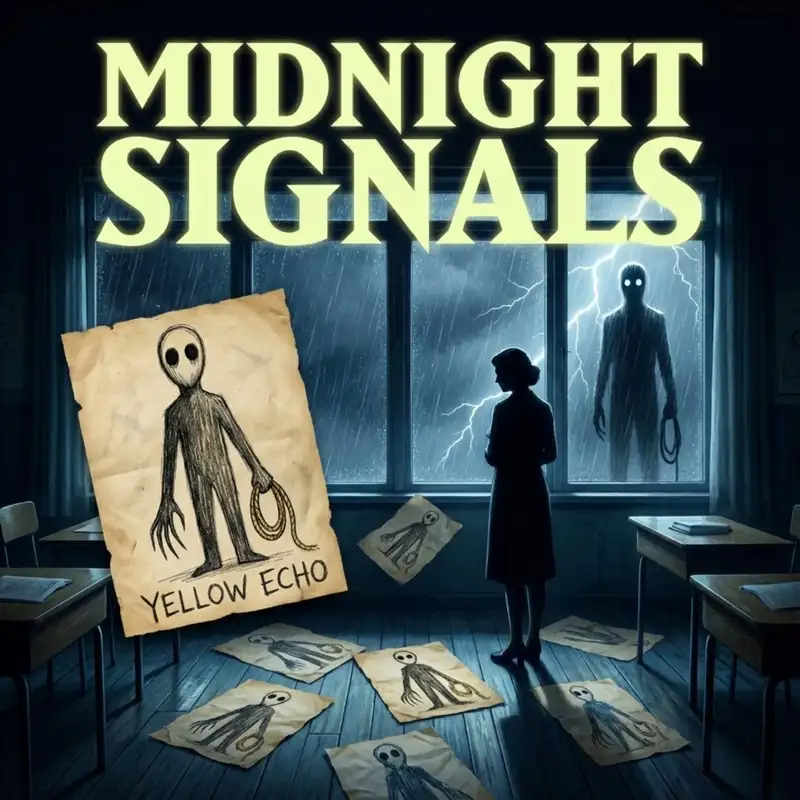
Spring, nineteen sixty two. Riverside Elementary School in Wyoming. Mrs. Patricia Hendrix handed out paper and crayons to her second grade class, giving them a simple assignment, draw an imaginary friend. Something from your mind, she told them, something only you can see.
Speaker 1:Thirty minutes later, she collected the drawings. The stack slipped from her hands. Paper scattered across the floor. Every single one showed the same figure. A tall man with no face.
Speaker 1:Hollow eye sockets where eyes should be. An elongated hand holding what looked like a cord or rope. The proportions matched exactly. The posture? The tilt of the head.
Speaker 1:Hendrix gathered the papers with shaking hands and walked straight to the principal's office. She didn't know yet that two other teachers, in two other classrooms were doing exactly this at that exact moment. 37 children, three separate rooms, no contact between the groups. All of them had drawn this faceless man. And when questioned separately, each child used the same name, Yellow Echo.
Speaker 1:School administrator Doctor. Raymond Foster separated the children immediately. He interviewed them one by one, taking careful notes. The transcripts showed details that shouldn't have matched. He stands by the window when it rains, one child said.
Speaker 1:Another interviewed an hour later in a different room. He only comes when it's raining, never any other time. They described his height consistently, taller than the doorway, his posture, head tilted slightly to one side, his eyes, not missing, but hollow, like they'd been scooped out. And the rope in his hand, which several children said made a clicking sound, though they couldn't explain how. Foster contacted the University of Washington Psychology Psychology A research team arrived within two days, led by Doctor.
Speaker 1:Ellen Marsh, who specialized in child psychology and group behavior. Her first hypothesis was simple: shared environmental trigger. A storybook illustration maybe? A local legend the children had all heard? The investigation turned up nothing.
Speaker 1:No common books, no shared media, no matching folklore in the area. The children came from different neighborhoods, attended different churches, had different family backgrounds. Some had never even spoken to each other before that day. Marsh photographed all 37 drawings. The images were cataloged and studied.
Speaker 1:The variations were minimal different crayon colors, slightly different line weights. But the figure itself remained consistent across every single page. Psychological evaluations showed no signs of coaching or coordination. The children weren't lying. They weren't rehearsing a story together.
Speaker 1:Three separate teachers had given the same assignment in three separate rooms on the same day. None of the classrooms had decorations or posters that matched the figure. The children had simply drawn what they saw in their minds, and their minds had all seen the same thing. The rain connection drew particular attention. Wyoming in spring means frequent rainfall, but the children were specific.
Speaker 1:He appeared only during rain. Not before, not after, only while it was actually falling. Several children mentioned he seemed to be waiting for something, watching them. One child said something that stuck with Marsh. He wants us to remember him.
Speaker 1:Marsh documented the case as a possible shared imagery phenomenon. Rare, but not impossible under specific psychological conditions. She explored stress factors, postwar anxiety, cold war fears filtering down through worried parents. Her theory suggested the children had unconsciously created a shared protective figure, or perhaps a warning symbol they couldn't fully articulate. Then everything vanished.
Speaker 1:05/15/1962. Less than two weeks after the incident, Mrs. Hendrix didn't show up for her morning classes. School staff went to her apartment and found it empty. Her belongings were still there.
Speaker 1:Her car sat in the parking lot. Her purse and wallet were on the kitchen counter. But Hendrix was gone. The 37 drawings disappeared the same day. They'd been stored in a locked filing cabinet in the principal's office.
Speaker 1:The cabinet wasn't damaged. No forced entry. Only two people had keys: Foster and Hendrix. Foster's key was accounted for. Hendrix's key had vanished with her.
Speaker 1:Police found no witnesses, no struggle, no explanation. Doctor. Marsh's research notes vanished from her university office. The photographs of the drawings, her interview transcripts, her analysis all gone. The only evidence that remained was Foster's handwritten notes and his memory of what he'd seen.
Speaker 1:Foster spent the rest of his career trying to reconstruct the case. He died in 1989 without answers. His archived notes were discovered in 2003, reigniting interest in the Yellow Echo incident. Modern psychologists still favor the shared imagery theory. Children's brains are highly susceptible to pattern recognition and unconscious synchronization.
Speaker 1:Environmental stress can create matching mental constructs. The rain could represent shared anxiety about storms, darkness, isolation. But the disappearances remain unexplained. The timing seems too Skeptics point out that no photographs of the original drawings survive, only descriptions. Could the entire case have been exaggerated over decades of retelling?
Speaker 1:Yet Foster's transcripts show consistent, specific details that would be difficult to fabricate. Some researchers suggest Hendrick suffered a breakdown, destroyed the evidence, and fled. But why? If this was simply a psychological phenomenon, why remove proof of a groundbreaking discovery? The 37 children are now in their late sixties and seventies.
Speaker 1:Most decline interviews. The few who've spoken remember him clearly. They insist he was real. We all saw him, one former student said in 2008. He was there.
Speaker 1:The evidence is gone. The teacher vanished. The truth sits somewhere between psychology and mystery. The human mind remains powerful and strange, especially in children who haven't learned what's impossible yet. This has been Midnight Signals.
Speaker 1:I'm Russ Chamberlain, guiding you through the shadows where history meets mystery. Until next time, stay vigilant, seek the hidden, and remember in every silence there is a signal, and in every signal, a story waiting to be told.