


This guide lists what the documents and studies show about Kaspar Hauser, in date order, with a source on every entry.
Listen to the episode: Kaspar Hauser: The Boy from the Dark Room
At a glance
Appeared: 26 May 1828, Nuremberg
Died: 17 December 1833, Ansbach
Origin: Never established. A Baden link was ruled out in 2024.
The letters, 1812
He arrived with two letters. Both pointed back to 1812.
30 April 1812. The birth date in the letter. The second letter, presented as written by his mother, gave his name as Kaspar and his birth date as 30 April 1812. Handwriting analysts later concluded that both letters were written by the same hand. [1] [2]
29 September 1812. A prince is born in Baden. The hereditary prince of Baden was born to Grand Duke Charles and Stéphanie de Beauharnais. The infant died on 16 October 1812. Later rumors claimed Hauser was this child, switched at birth. [1]
7 October 1812. The custody date. The anonymous first letter said its writer took the boy in as an infant on this date, and taught him reading, writing and the Christian religion without letting him leave the house. [1] [2]
Nuremberg, 1828 to 1831
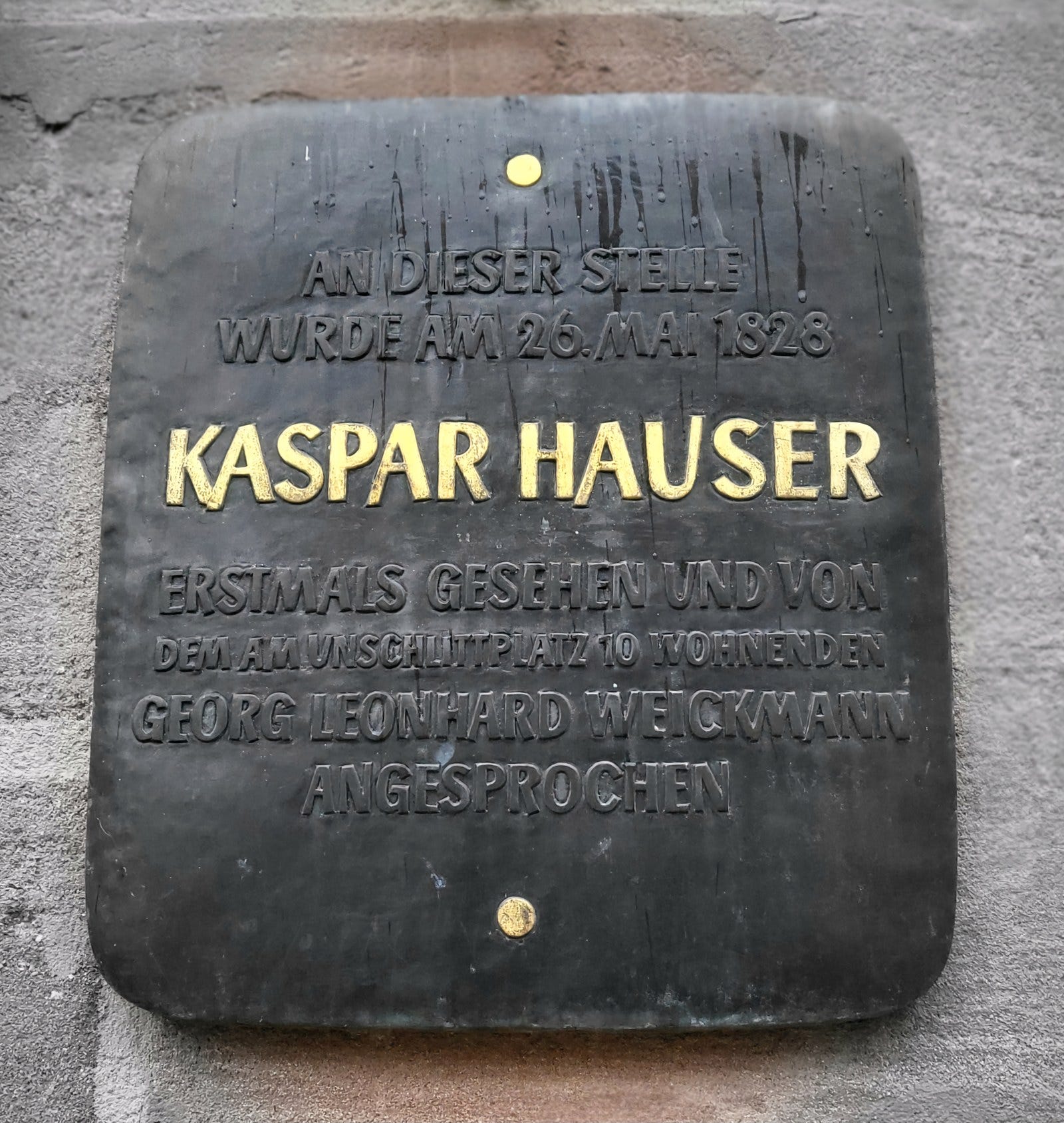
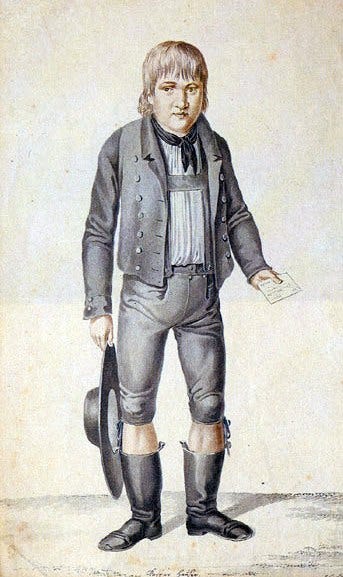
26 May 1828. A boy in Nuremberg. A teenage boy was found in Nuremberg carrying two letters. The first was addressed to Captain von Wessenig of the 4th squadron of the 6th cavalry regiment. A shoemaker named Weickmann took him to the captain’s house, where he repeated, “I want to be a cavalryman, as my father was.” [1] [2]
1828. Luginsland Tower, then Daumer. He was treated at first as a vagrant and spent about two months in Luginsland Tower at Nuremberg Castle, in the care of the jailer Andreas Hiltel. The town then placed him with the schoolmaster Georg Friedrich Daumer. [1] [2] [12]
17 October 1829. The first wound. He was found in the cellar of Daumer’s house, bleeding from a cut to the forehead, and said a hooded man had attacked him. Skeptics believed the wound was self-inflicted. [1]
3 April 1830. The pistol in the Biberbach house. A pistol went off in his room at the house of Johann Biberbach, a municipal official. He said he had grabbed it while falling from a chair. [1]
Stanhope and Ansbach, 1831 to 1833
Late 1831. Lord Stanhope, and Ansbach. The British nobleman Lord Stanhope gained custody of him. In December 1831 Stanhope moved him to the schoolmaster Johann Georg Meyer in Ansbach. Britannica dates Stanhope’s protection to 1832. [1] [2]
The court garden, December 1833
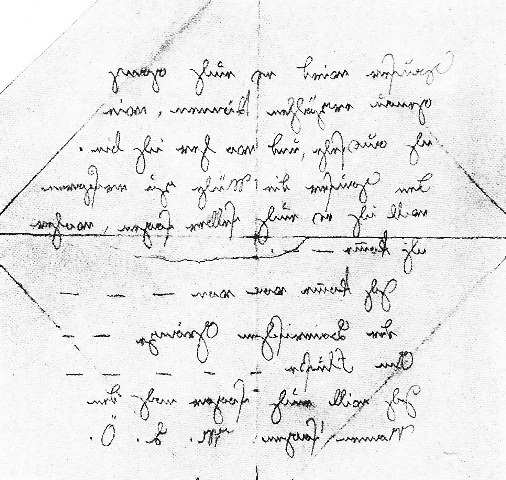
14 December 1833. The court garden. He came back to Meyer’s house with a deep chest wound and said a stranger had stabbed him in the Ansbach Court Garden while handing him a purse. Police found a small violet purse there. It held a pencilled note in mirror writing. [1] [5]
17 December 1833. Death in Ansbach. He died of the wound three days later and was buried in the Stadtfriedhof, the city cemetery of Ansbach. His headstone reads, in Latin: “Here lies Kaspar Hauser, riddle of his time. His birth was unknown, his death mysterious. 1833.” [1] [2]
What was tested
November 1996. The first DNA test. Der Spiegel reported a genetic test on a blood sample from underwear thought to be his. Comparison with descendants of the princely family showed that the blood could not have come from the hereditary prince of Baden. [1]
2023. The vaccination scars. A paper in Clinics in Dermatology examined whether his scars came from smallpox vaccination, which had been compulsory in Bavaria since 1807. If so, an adult would have taken him to be vaccinated. [4] [1]
2024. The Baden DNA study. A study in iScience found that the mitochondrial DNA in all samples attributed to Hauser, including the blood sample, was identical and different from the House of Baden lineage. [3] [1]
Theories and open questions
The prince theory. From around 1829, rumors held that he was the hereditary prince of Baden, switched at birth in 1812. DNA work in 1996 and 2024 ruled this out. [1] [3]
The impostor view. Several people who cared for him accused him of lying, and the Ansbach court of enquiry suspected he wounded himself. Lord Stanhope later published a book setting out the evidence against him. [1]
Still unknown. Where he came from, and how he received the fatal wound. [1] [2]
The places
Nuremberg and Ansbach are about 40 km apart in a straight line.
Unschlittplatz, Nuremberg. 26 May 1828. He was found here, in front of the houses at numbers 9 to 11, by the shoemakers Weickmann and Beck. A memorial plaque marks the spot today. [6] [7]
Nuremberg Castle, Luginsland Tower. 1828. Held for about two months in the care of the jailer Andreas Hiltel. [1] [8]
Hofgarten (court garden), Ansbach. 14 December 1833. He said a stranger stabbed him here, near the Uz monument, while handing him a purse. [6] [9]
Stadtfriedhof, Ansbach. December 1833. The city cemetery, where he is buried. [1] [10]
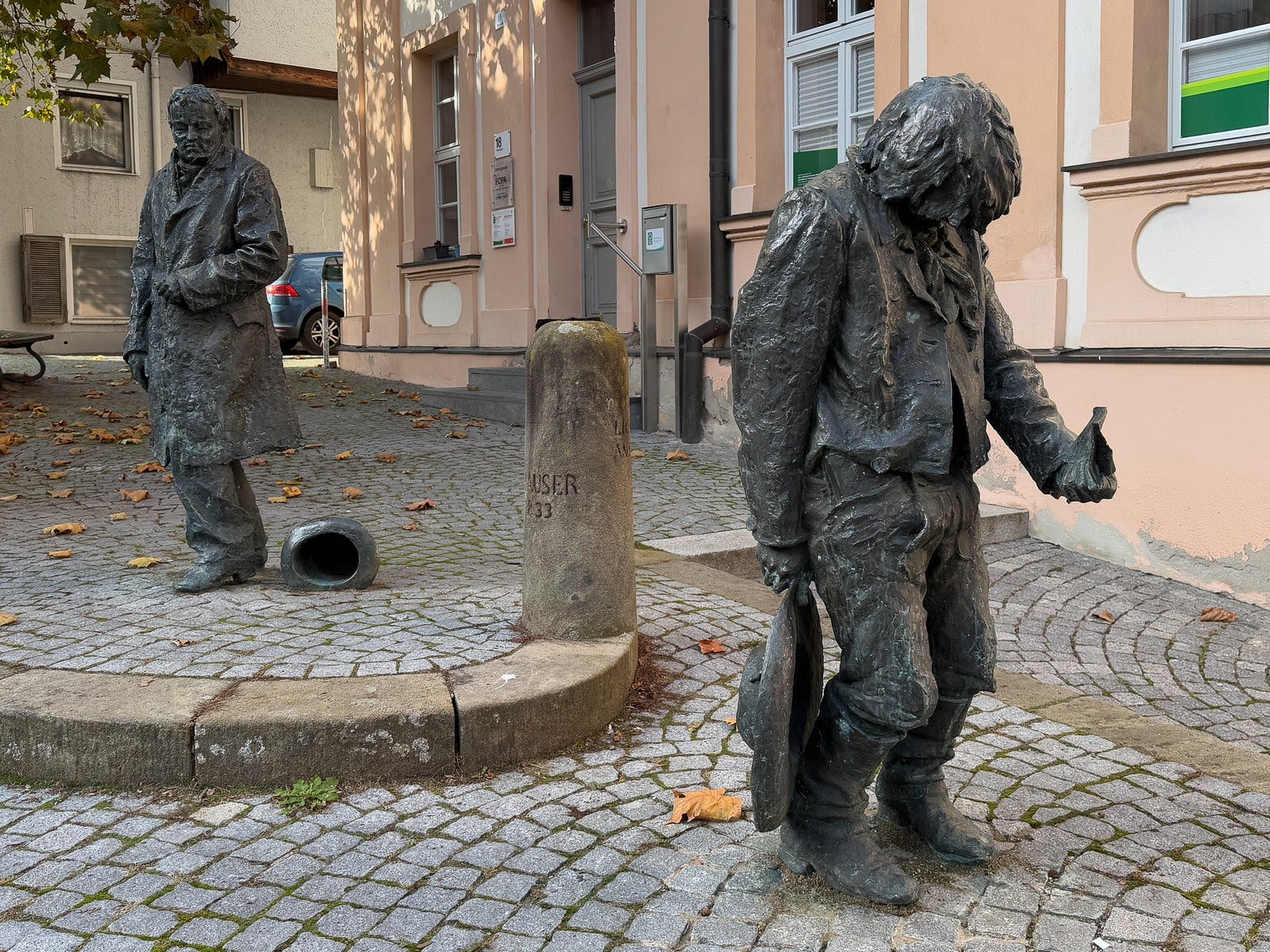
Kaspar Hauser monument, Ansbach. Today. Two sculptures by Friedrich Schelle. It was put up after his death and is not a site from his life. [11]
Questions
Was Kaspar Hauser the lost prince of Baden? No record or study has established who he was. A 2024 DNA study ruled out the Baden link through his mother’s line. [3]
How did Kaspar Hauser die? He died on 17 December 1833, three days after a stab wound to the chest. He said a stranger attacked him in the Ansbach Court Garden. The Ansbach court of enquiry suspected that the wound was self-inflicted. A 2005 forensic analysis found it unlikely that the wound was meant only as self-harm, but said that neither suicide nor homicide could be definitely ruled out. [1]
What did the mirror-writing note say? In translation: “Hauser will be able to tell you quite precisely how I look and from where I am. To save Hauser the effort, I want to tell you myself from where I come [gap]. I come from [gap] the Bavarian border [gap] On the river [gap] I will even tell you the name: M. L. Ö.” The gaps are in the original note. [1] [5]
Where is Kaspar Hauser buried? In the Stadtfriedhof, the city cemetery of Ansbach in Bavaria. [1]
Listen
The full story is in the episode: Kaspar Hauser: The Boy from the Dark Room
Sources
Wikipedia, “Kaspar Hauser” (accessed Oct 27, 2026). en.wikipedia.org/wiki/Kaspar_Hauser
Encyclopaedia Britannica, “Kaspar Hauser.” britannica.com/biography/Kaspar-Hauser
Parson, W. et al. (2024). “Kaspar Hauser’s alleged noble origin: New molecular genetic analyses resolve the controversy.” iScience. doi.org/10.1016/j.isci.2024.110539
Habicht, M. E. et al. (2023). “Kaspar Hauser, the Child of Europe: Are smallpox vaccination scars the clue to a 2-century-old mystery?” Clinics in Dermatology. doi.org/10.1016/j.clindermatol.2023.06.001
Wikimedia Commons, the mirror-writing note, with translation. commons.wikimedia.org
Wikipedia (German), “Kaspar Hauser” (accessed Oct 27, 2026). de.wikipedia.org/wiki/Kaspar_Hauser
Wikidata Q2496747, Unschlittplatz (coordinates). wikidata.org/wiki/Q2496747
Wikidata Q707396, Nuremberg Castle (coordinates). wikidata.org/wiki/Q707396
Wikidata Q26898120, Hofgarten Ansbach (coordinates). wikidata.org/wiki/Q26898120
Wikidata Q98620895, Stadtfriedhof Ansbach (coordinates). wikidata.org/wiki/Q98620895
Wikidata Q126901042, Kaspar Hauser monument, Ansbach. wikidata.org/wiki/Q126901042
Wikipedia, “Georg Friedrich Daumer” (accessed Oct 27, 2026). en.wikipedia.org/wiki/Georg_Friedrich_Daumer

Image credits
Portrait of Kaspar Hauser, Johann Georg Laminit, 1828/29. Public domain. Wikimedia Commons
Memorial plaque, Unschlittplatz, Nuremberg. Photo: Ludmila Zellner Rotbauerová, CC BY-SA 4.0. Wikimedia Commons
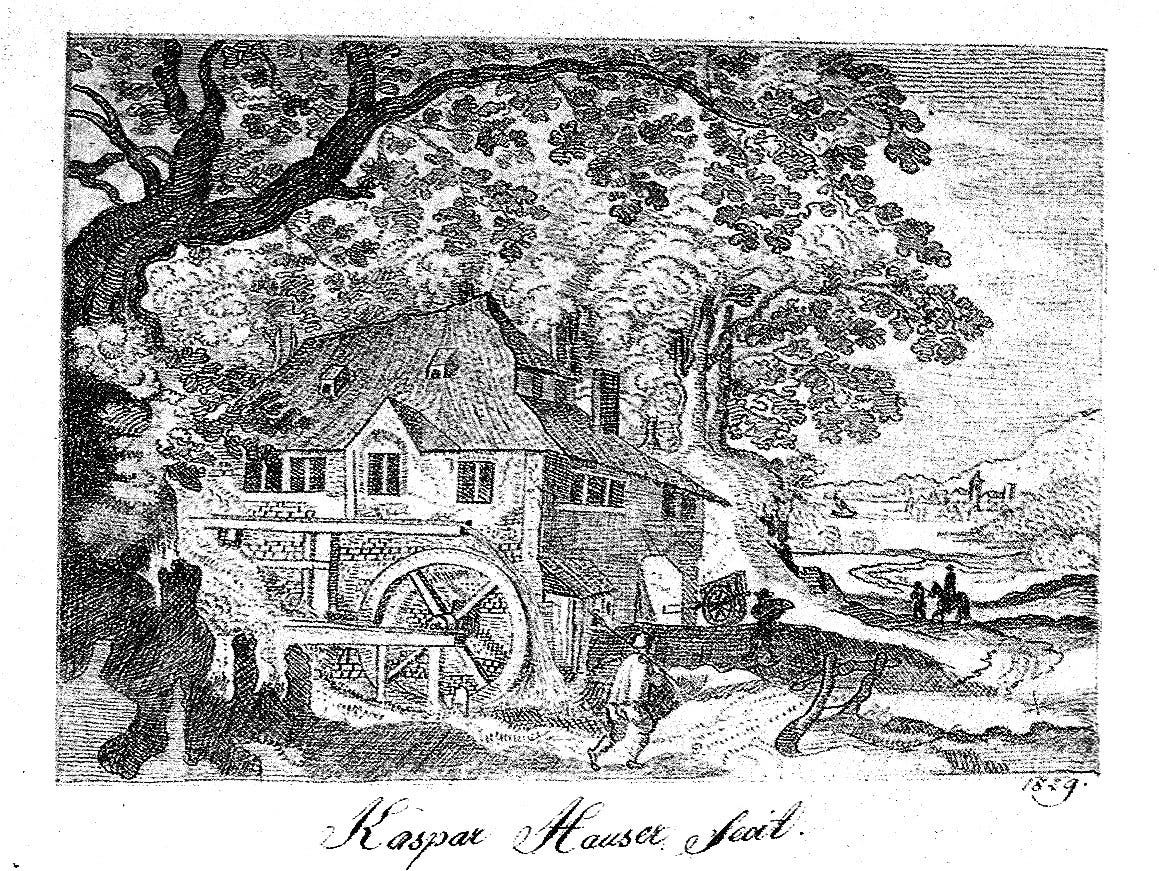
Pencil drawing of a mill, Kaspar Hauser, 1829. Stadtarchiv Ansbach. Public domain. Wikimedia Commons
The mirror-writing note, 1833. Public domain. Wikimedia Commons
Kaspar Hauser monument by Friedrich Schelle, Ansbach. Photo: Thilo Parg, CC BY-SA 4.0. Wikimedia Commons


